Licence: In copyright
Credit: The chemistry of nerve-degeneration / F.W. Mott. Source: Wellcome Collection.
Provider: This material has been provided by The University of Glasgow Library. The original may be consulted at The University of Glasgow Library.
3/38 page 437
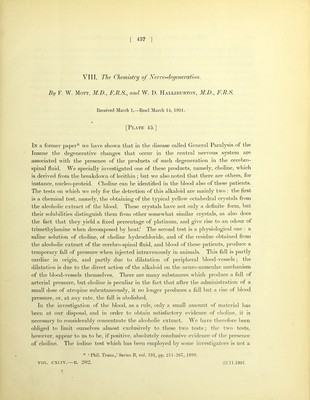
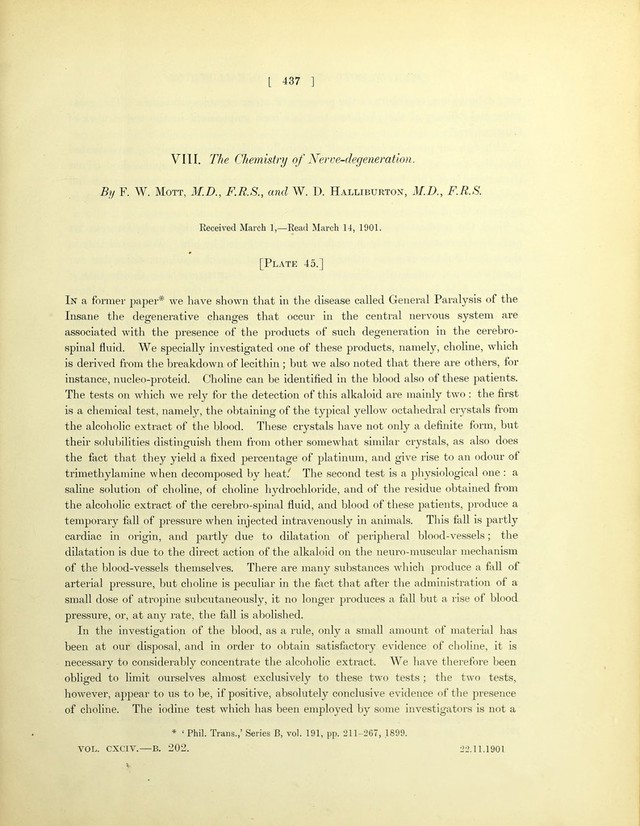
![VIII. The Chemistry of Nerve-degeneration. By F. W. Mott, M.D., F.R.S., and W. D. Halliburton, M.D., F.R.S. Received March 1,—Read March IT, 1901. [Plate 45.] In a former paper* we have shown that in the disease called General Paralysis of the Insane the degenerative changes that occur in the central nervous system are associated with the presence of the products of such degeneration in the cerebro- spinal fluid. We specially investigated one of these products, namely, choline, which is derived from the breakdown of lecithin ; but we also noted that there are others, for instance, nucleo-proteid. Choline can he identified in the blood also of these patients. The tests on which we rely for the detection of this alkaloid are mainly two : the first is a chemical test, namely, the obtaining of the typical yellow octahedral crystals from the alcoholic extract of the blood. These crystals have not only a definite form, but their solubilities distinguish them from other somewhat similar crystals, as also does the fact that they yield a fixed percentage of platinum, and give rise to an odour of trimethylamine when decomposed by heat.' The second test is a physiological one : a saline solution of choline, of choline hydrochloride, and of the residue obtained from the alcoholic extract of the cerebro-spinal fluid, and blood of these patients, produce a temporary fall of pressure when injected intravenously in animals. This fall is partly cardiac in origin, and partly due to dilatation of peripheral blood-vessels; the dilatation is due to the direct action of the alkaloid on the neuro-muscular mechanism of the blood-vessels themselves. There are many substances which produce a fall of arterial pressure, but choline is jDeculiar in the fact that after the administration of a small dose of atropine subcutaneously, it no longer produces a fall but a rise of blood pressure, or, at any rate, the fall is abolished. In the investigation of the blood, as a rule, only a small amount of material has been at our disposal, and in order to obtain satisfactory evidence of choline, it is necessary to considerably concentrate the alcoholic extract. We have therefore been obliged to limit ourselves almost exclusively to these two tests ; the two tests, however, appear to us to be, if positive, absolutely conclusive evidence of the presence of choline. The iodine test which has been employed by some investigators is not a * ‘ Phil. Trans.,’ Series B, vol. 191, pp. 211-267, 1899. VOL. CXCIV.—B, 202. 22.11.1901 V](https://iiif.wellcomecollection.org/image/b24917254_0005.jp2/full/800%2C/0/default.jpg)