A textbook of biochemistry for students of medicine and science / A.T. Cameron.
- Alexander Thomas Cameron
- Date:
- 1942
Licence: In copyright
Credit: A textbook of biochemistry for students of medicine and science / A.T. Cameron. Source: Wellcome Collection.
90/398 (page 74)
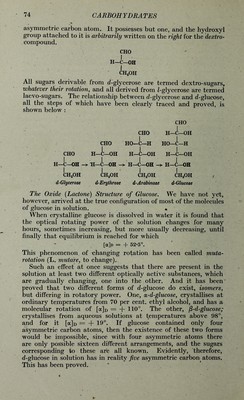
![asymmetric carbon atom. It possesses but one, and the hydroxyl group attached to it is arbitrarily written on the right for the dextro- compound. CHO H—C—OH CH2OH All sugars derivable from d-glycerose are termed dextro-sugars, whatever their rotation, and all derived from Z-glycerose are termed laevo-sugars. The relationship between d-glycerose and d-glucose, all the steps of which have been clearly traced and proved, is shown below : CHO CHO 1 H—C—OH | CHO | HO—C—H 1 HO—C—H 1 CHO H—C—OH H—C—OH H—C—OH H—C—OH -> H—A—OH —> H—C—OH -> H—OH | ch2oh CH2OH CH2OH CH2OH d-Glycerose d-Erythrose d-Arabinoss d-Glucose The Oxide (Lactone) Structure of Glucose. We have not yet, however, arrived at the true configuration of most of the molecules of glucose in solution. * When crystalline glucose is dissolved in water it is found that the optical rotating power of the solution changes for many hours, sometimes increasing, but more usually decreasing, until finally that equilibrium is reached for which [a]D = + 52-5°. This phenomenon of changing rotation has been called muta- rotation (L. mutaire, to change). Such an effect at once suggests that there are present in the splution at least two different optically active substances, which are gradually changing, one into the other. And it has been proved that two different forms of d-glucose do exist, isomers, but differing in rotatory power. One, on-d-glucose, crystallises at ordinary temperatures from 70 per cent, ethyl alcohol, and has a molecular rotation of [a]o — + 110°. The other, fi-d-glucose; crystallises from aqueous solutions at temperatures above 98°, and for it [oc]d = + 19°. If glucose contained only four asymmetric carbon atoms, then the existence of these two forms would be impossible, since with four asymmetric atoms there are only possible sixteen different arrangements, and the sugars corresponding to these are all known. Evidently, therefore, d-glucose in solution has in reality five asymmetric carbon atoms. This has been proved.](https://iiif.wellcomecollection.org/image/b29807335_0090.jp2/full/800%2C/0/default.jpg)