Heywood & Massey's lunacy practice / by N. Arthur Heywood, Arnold S. Massey and Ralph C. Romer.
- Heywood, N. Arthur (Nathaniel Arthur)
- Date:
- 1907
Licence: In copyright
Credit: Heywood & Massey's lunacy practice / by N. Arthur Heywood, Arnold S. Massey and Ralph C. Romer. Source: Wellcome Collection.
Provider: This material has been provided by King’s College London. The original may be consulted at King’s College London.
43/708 page 3
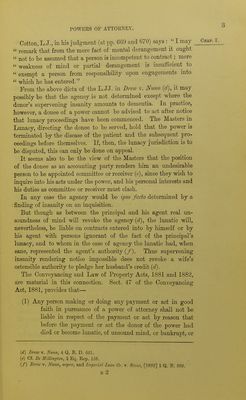
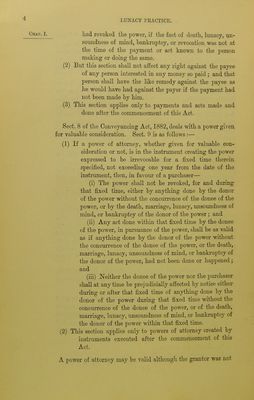
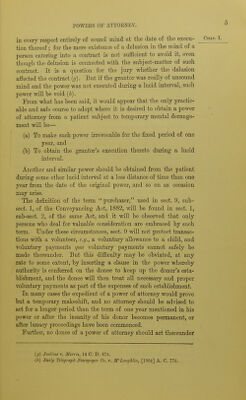
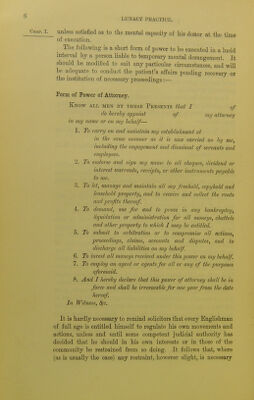
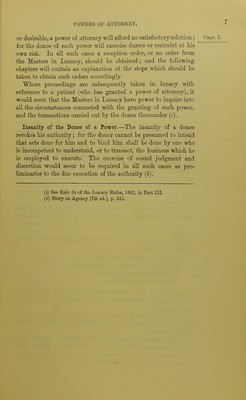
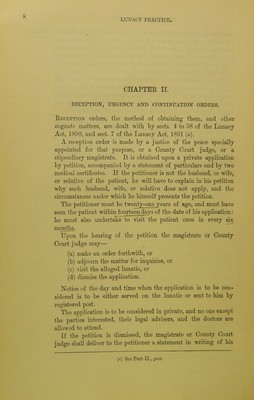
![Cotton, LJ., in his judgment (at pp. 669 and 670) says : I may remark that from the mere fact of mental derangement it ought not to be assumed that a person is incompetent to contract; mere weakness of mind or partial derangement is insufficient to exempt a person from responsibility upon engagements into which he has entered. From the above dicta of the L.J J. in Brew v. Nunn (d), it may possibly be that the agency is not determined except where the donor's supervening insanity amounts to dementia. In practice, however, a donee of a power cannot be advised to act after notice that lunacy proceedings have been commenced. The Masters in Lunacy, directing the donee to be served, hold that the power is terminated by the disease of the patient and the subsequent pro- ceedings before themselves. If, then, the lunacy jurisdiction is to be disputed, this can only be done on appeal. It seems also to be the view of the Masters that the position of the donee as an accounting party renders him an undesirable person to be appointed committee or receiver (e), since they wish to inquire into his acts under the power, and his personal interests and his duties as committee or receiver must clash. In any case the agency would be ipso facto determined by a : finding of insanity on an inquisition. But though as between the principal and his agent real im- soundness of mind will revoke the agency (d), the lunatic wUl, nevertheless, be liable on contracts entered into by himself or by his agent with persons ignorant of the fact of the principal's lunacy, and to whom in the case of agency the lunatic had, when sane, represented the agent's authority (/). Thus supervening insanity rendering notice impossible does not revoke a wife's ostensible authority to pledge her husband's credit (d). The Conveyancing and Law of Property Acts, 1881 and 1882, are material in this connection. Sect. 47 of the Conveyancing Act, 1881, provides that— (1) Any person making or doing any pajment or act in good faith in pursuance of a power of attorney shall not be liable in respect of the payment or act by reason that before the payment or act the donor of the power had died or become lunatic, of unsound mind, or bankrupt, or (d) Drew v. Nunn, 4 Q. B. D. 661. (e) Cf. Re Millington, 2 Eq. Rep. 158. (/) Brew V. Nimn, mpm, and Imperial loan Co. v, Stone, [1892] 1 Q. B. 599, b2](https://iiif.wellcomecollection.org/image/b2129561x_0043.jp2/full/800%2C/0/default.jpg)
 No text description is available for this image
 No text description is available for this image
 No text description is available for this image