Stöhr's histology : arranged upon an embroyological basis / by Dr. Frederic T. Lewis ... From the 12th German ed. by Philipp Stöhr ... 6th American ed., with 450 illustrations.
- Philipp Stöhr
- Date:
- 1906
Licence: Public Domain Mark
Credit: Stöhr's histology : arranged upon an embroyological basis / by Dr. Frederic T. Lewis ... From the 12th German ed. by Philipp Stöhr ... 6th American ed., with 450 illustrations. Source: Wellcome Collection.
Provider: This material has been provided by the Augustus C. Long Health Sciences Library at Columbia University and Columbia University Libraries/Information Services, through the Medical Heritage Library. The original may be consulted at the the Augustus C. Long Health Sciences Library at Columbia University and Columbia University.
18/452 (page 6)
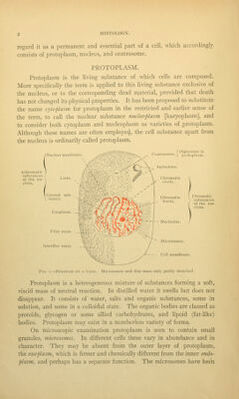
![body, the centriole. Such centrosomes have been observed in the in- vertebrate animals. The cells of vertebrates are not regarded as favorable for investigations of the finer structure of centrosomes. In them generally both centroplasm and centriole appear as a single small granule, the centrosome. This granule is usually, but not always, surrounded by a zone of protoplasm which is so modified as to form a darker or a lighter area, the archoplasm (Fig. i). (The archoplasm of certain spermatic cells is called the idiozome.) The centrosome may be near the nucleus or distant from it, frequently being found between the nucleus and the free surface of the cell. Rarely, as in a few invertebrates and in cancer cells, ^ the centrosome has been found within the nucleus. In many gland cells it lies where the secretion accumulates, the expulsion of wliich is accom- plished by the contraction of the protoplasmic framework between the masses of secretion. In the intestinal epithehal cells which send out motile projections of protoplasm (pseudopodia), the centrosome lies just beneath the place of origin of these projections. If one considers also the relation of the centrosome in the spermatozoa as well as its role in cell division, it seems almost certain that the centrosome is the active or passive center of the motor functions. In connection with cell division, the centrosome undergoes a cycle of changes of varying duration. That stage which is continued longest is characterized by a doubling of the centrosome, following the division of the centriole in two. The double body thus formed is the diplosome. In many resting cells, or those not actually in the process of division, a diplosome is found, and this is signifi- cant as indicating the readiness of the cell for undergoing division without delay. CELL WALL. A cell wall or cell membrane is an independent membranous layer covering a cell and being clearly distinct from the underlying protoplasm. It is not an essential constituent of a cell. Often it is lacking, and when present it is either a modification or a secretion of the peripheral protoplasm. If the membrane surrounds the cell on all sides it is called a pellicula; if it is on only one side, covering the free surface, it is a cuticula. (The former term is seldom used.) Cells may unite with one another by proto- plasmic processes of varying length and width, thus forming cellular networks; or they may completely fuse so that their nuclei appear irregu- larly distributed through a single mass of protoplasm. Such a formation is a syncytium [plasmodium]. This name is apphed also to such structures as the striated muscle fiber, due not to the fusion of cells but to the multi- plication of nuclei in an undivided mass of protoplasm.](https://iiif.wellcomecollection.org/image/b21206375_0018.jp2/full/800%2C/0/default.jpg)