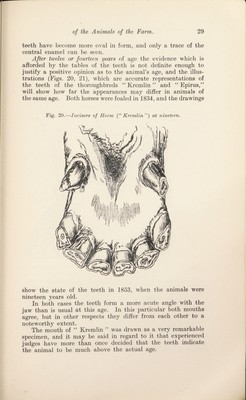
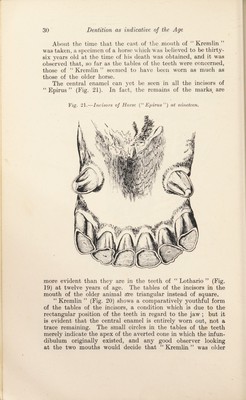
Dentition as indicative of the age of the animals of the farm / by Sir George T. Brown.
- George Thomas Brown
- Date:
- 1927
Licence: Public Domain Mark
Credit: Dentition as indicative of the age of the animals of the farm / by Sir George T. Brown. Source: Wellcome Collection.
33/68 page 31
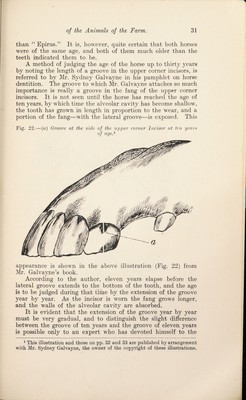
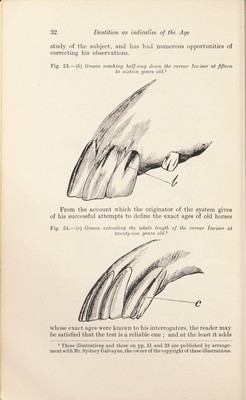
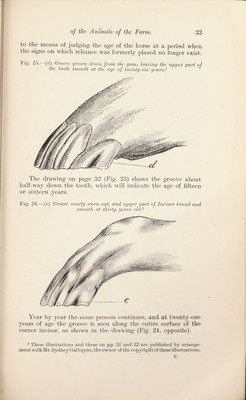
![than “ Epirus.” It is, however, quite certain that both horses were of the same age, and both of them much older than the teeth indicated them to be. A method of judging the age of the horse up to thirty years by noting the length of a groove in the upper corner incisors, is referred to by ]\Ir. Sydney Galvayne in his pamphlet on horse dentition. The groove to which Mr. Galvayne attaches so much importance is really a groove in the fang of the upper corner incisors. It is not seen until the horse has reached the age of ten years, by which time the alveolar cavity has become shallow, the tooth has grovui in length in proportion to the wear, and a portion of the fang—with the lateral groove—is exposed. This Fig. 22.—(a) Groove at the side of the upper corner Incisor at ten years of age.^ appearance is shown in the above illustration (Fig. 22) from Mr. Galvayne’s book. According to the author, eleven years elapse before the lateral groove extends to the bottom of the tooth, and the age is to be judged during that time by the extension of the groove year by year. As the incisor is worn the fang grows longer, and the walls of the alveolar cavity are absorbed. It is evident that the extension of the groove year by year must be very gradual, and to distinguish the slight difference between the groove of ten years and the groove of eleven years is possible only to an expert who has devoted himself to the ^ This illustration and those on pp. 32 and 33 are published by arrangement with Mr. Sydney Galvayne, the owner of the copyright of these illustrations.](https://iiif.wellcomecollection.org/image/b29820121_0033.jp2/full/800%2C/0/default.jpg)