Lessons on the anatomy, physiology and hygiene of infancy and childhood for junior students : Consisting of extracts from lectures given at Rush medical college / by Alfred C. Cotton.
- Cotton, Alfred Cleveland, 1847-1916
- Date:
- 1900
Licence: Public Domain Mark
Credit: Lessons on the anatomy, physiology and hygiene of infancy and childhood for junior students : Consisting of extracts from lectures given at Rush medical college / by Alfred C. Cotton. Source: Wellcome Collection.
Provider: This material has been provided by the Harvey Cushing/John Hay Whitney Medical Library at Yale University, through the Medical Heritage Library. The original may be consulted at the Harvey Cushing/John Hay Whitney Medical Library at Yale University.
99/264 (page 47)
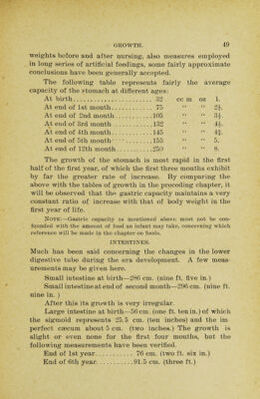
![is a point of interest as it explains the tendency to renai -congestion and inflammation so noticeable in young children. THYROID. As childhood advances, with the disappearance of sub- •cutaneous fat and the sinking of the manubrium sterni, the thyroid gland becomes more evident and can more easily be outlined. The fluid contained in its cells, which in the fcBtus and. new born is serious in character, changes gradu- ally to a colloid material. Not infrequently the thyroid in- creases in size at the apf)roach of puberty. THYMUS. The thymus increases in size up to the end of the second year; it is then stationary until the sixth year, after which it gradually atrophies, disappearing from the neck and from behind the middle third of the sternum, its only vestige being a mass of fatty tissue in the superior mediastinal space. The atrophy is associated with a closer appx'oxi- mation of the pleurae and lungs, behind the steruum. CHAPTER VI. (Growth continued). ALIMENTARY TRACT. Within the first few weeks of life the mucosa of the mouth loses its dusky hyperaemic appearance and at the same time the so-called epithelial pearls—small, yellowish white nodules frequently found in the median line of the hard palate—disap|iear. The tongue and buccal surfaces become more moist with the increasing secretions from the buccal, labial and salivary glands. The characteristic coating of the baby tongue persists during the greater part of the nursing period. The roof of the mouth gradually becomes more arched with the develop- ment of the alveolar ridges. The velum ]ialati becomes ampler as it descends to its more vertical position, the](https://iiif.wellcomecollection.org/image/b2102876x_0099.jp2/full/800%2C/0/default.jpg)