The Cat-Stane, Edinburghshire : is it not the tombstone of the grandfather of Hengist and Horsa? / by J. Y. Simpson.
- James Young Simpson
- Date:
- 1862
Licence: Public Domain Mark
Credit: The Cat-Stane, Edinburghshire : is it not the tombstone of the grandfather of Hengist and Horsa? / by J. Y. Simpson. Source: Wellcome Collection.
Provider: This material has been provided by Royal College of Physicians, London. The original may be consulted at Royal College of Physicians, London.
13/64 (page 9)
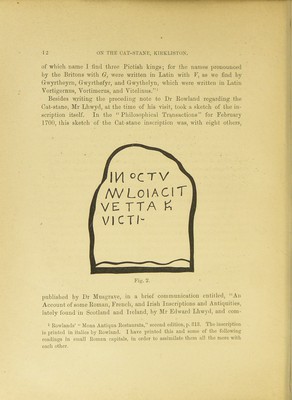
![and that had very evidently been already searched and harried. I shall indeed have immediately occasion to cite a passage proving that a cen- tury and a half ago the present pillar-stone was surrounded, like some other ancient graves, by a circular range of large flat-laid stones; and when this outer circle was removed,—if not before,—the vicinity and base of the central pillar were very probably dug into and disturbed. Different Readings of the Inscription. The inscription upon the stone is cut on the upper half of the eastern and narrowest face of the triangular monolith. Various descriptions of the legend have been given by different authors. The latest published account of it is that given by Professor Daniel Wilson in his work on Scottish Archaeology. He disposes of the stone and its inscription in the two following short sentences :—“ A few miles to the westward of this is the oft-noted Catt Stane in Kirkliston parish, on which the painful antiquary may yet decipher the imperfect and rudely lettered inscrip- tion,—the work, most probably, of much younger hands than those that reared the mass of dark whinstone on which it is cut,—IN [H]OC TVMVLO IACET VETTA . . VICTR . . About sixty yards to the west of the Cat-staue a large tumulus formerly stood, which was opened in 1824, and found to contain several complete skeletons; but nearly all traces of it have now disappeared.”1 In the tenth volume of the Statistical Account of Scotland, collected by Sir John Sinclair, and published in 1794, the Rev. Mr John Muckarsie, in giving an account of the parish of Kirkliston, alludes in a note to the “ Cat-stane standing on the farm of that name in this parish.” In de- far more speedily. On another part of Mrs Ramsay's property, namely, in the policy and within two hundred yards of the mansion-house of Barnton, I opened, several years ago, with Mr Morritt of Rokeby, the grave of a woman who had died as the tombstone on the spot told us—during the last Scottish plague in the year 1648 The only remains of sepulture which we found were some fragments of the wooden coffin, and the enamel crowns of a few teeth. All other parts of the body and skele- ton had entirely disappeared. The chemical qualities of the ground, and conse- quently of its water, will of course modify the rapidity of such results. 1 Prehistoric Annals of Scotland, p. 96.](https://iiif.wellcomecollection.org/image/b28270976_0013.jp2/full/800%2C/0/default.jpg)