The use of litmus paper as a quantitative indicator of reaction / by G.S. Walpole.
- Walpole, George Stanley.
- Date:
- [1913?]
Licence: Public Domain Mark
Credit: The use of litmus paper as a quantitative indicator of reaction / by G.S. Walpole. Source: Wellcome Collection.
3/12
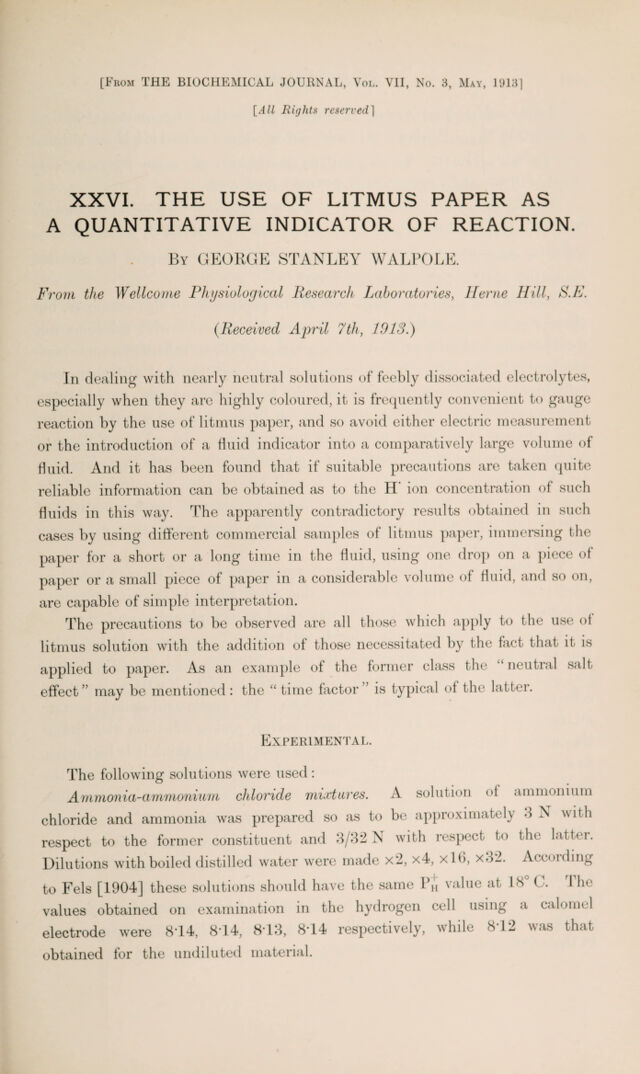
![[All Rights reserved] XXVI. THE USE OF LITMUS PAPER AS A QUANTITATIVE INDICATOR OF REACTION. By GEORGE STANLEY WALPOLE. From the Wellcome Physiological Research Laboratories, Horne Hill, S.F. (.Received April 7th, 1913.) In dealing with nearly neutral solutions of feebly dissociated electrolytes, especially when they are highly coloured, it is frequently convenient to gauge reaction by the use of litmus paper, and so avoid either electric measurement or the introduction of a fluid indicator into a comparatively large volume of fluid. And it has been found that if suitable precautions are taken quite reliable information can be obtained as to the H’ ion concentration of such fluids in this way. The apparently contradictory results obtained in such cases by using different commercial samples of litmus paper, immersing the paper for a short or a long time in the fluid, using one drop on a piece of paper or a small piece of paper in a considerable volume of fluid, and so on, are capable of simple interpretation. The precautions to be observed are all those which apply to the use of litmus solution with the addition of those necessitated by the fact that it is applied to paper. As an example of the former class the “ neutral salt effect ” may be mentioned : the “ time factor is typical of the latter. Experimental. The following solutions were used: Ammonia-ammonium chloride mixtures. A solution of ammonium chloride and ammonia was prepared so as to be approximately 3 X w it h respect to the former constituent and 3/32 X with respect to the lattei. Dilutions with boiled distilled water were made x2, x4, xlb, x32. Accoiding to Fels [1904] these solutions should have the same 1*h value at IN ( . I he values obtained on examination in the hydrogen cell using a calomel electrode were 814, 814, 813, 814 respectively, while 812 was that obtained for the undiluted material.](https://iiif.wellcomecollection.org/image/b30620338_0003.jp2/full/800%2C/0/default.jpg)