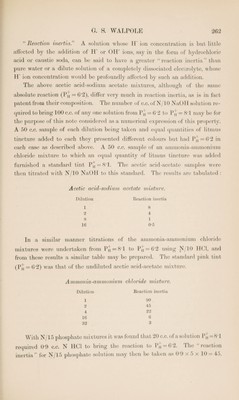
The use of litmus paper as a quantitative indicator of reaction / by G.S. Walpole.
- Walpole, George Stanley.
- Date:
- [1913?]
Licence: Public Domain Mark
Credit: The use of litmus paper as a quantitative indicator of reaction / by G.S. Walpole. Source: Wellcome Collection.
4/12 page 261
![Acetic acid-sodiam acetate mixtures. A solution of commercial sodium acetate 061 N, containing acetic acid corresponding to 0*61/64 N was diluted xl, x2, x8 and xl6. These solutions should have the same Ph value very closely. The values found were 6*25, 6*20, 6*27, 6*23. Neutral phosphate solution. This was a mixture of 68*8 c.c. of Sorensen’s N/15 Na2HP04 solution, and 131*2 c.c. of his N/15 KH2P04 solution. The P,j value determined was 7*05. The figure at present accepted for absolute neutrality is P^ — 7*07 [Sorensen, 1909]. Solutions of serum globulin and Witte peptone were also examined, but they presented, in addition to the phenomena observed with solutions free from proteins and their primary disintegration products, others of a more com¬ plex and different order. For this reason it was decided to deal with them more fully in a separate communication and cite here only one or two typical cases. Litmus solution. The reaction between litmus solution and the solution with which it is mixed is practically instantaneous. In saline solutions it gives an indication of the reaction of the solution subject only to a correction for the “neutral salt effect”: for it is well known that, for solutions of the same H’ ion concentration, indicators in the presence of larger quantities of neutral salt give slightly different colours from those which they give when little salt is present [Sorensen, 1912]. The litmus tincture used was itself apparently neutral, or very nearly so, since it gave almost exactly the same tint when added in the same quantity to equal volumes of boiled distilled water and neutral phosphate solution. The ammonia-ammonium chloride mixtures all gave precisely the same tint as far as could be observed with litmus solution, with the exception of the x32 dilution, 100 c.c. of which required 0*02 c.c. N/10 NaOH to bring the colour to the same tint as that of the others. The acetic acid-sodium acetate mixtures, on the other hand, gave progressively pinker solutions with litmus tincture as dilution increased. From this observation I think it is legitimate to draw the conclusion that the neutral salt effect is observable in all the acetic acid-acetate mixtures, and only in one case in the ammonia-ammonium chloride mixtures. This is probably due to the fact that the P^ value of the latter mixture is near the alkaline limit of the sensitive range of litmus. “ Equilibrium tint.” If a small piece of litmus paper be introduced into a comparatively large volume of any of these solutions it will, after a lapse of a longer or shorter time, assume a definite tint which undergoes no further change. This it is proposed to call the “ equilibrium tint ” of the paper used in the solution under consideration.](https://iiif.wellcomecollection.org/image/b30620338_0004.jp2/full/800%2C/0/default.jpg)