Manual of clinical diagnosis / by Otto Seifert and Friedrich von Müller; translated by William Buckingham Canfield.
- Seifert, Heinrich Wilhelm Otto, 1853-1933.
- Date:
- 1887
Licence: Public Domain Mark
Credit: Manual of clinical diagnosis / by Otto Seifert and Friedrich von Müller; translated by William Buckingham Canfield. Source: Wellcome Collection.
Provider: This material has been provided by the Augustus C. Long Health Sciences Library at Columbia University and Columbia University Libraries/Information Services, through the Medical Heritage Library. The original may be consulted at the the Augustus C. Long Health Sciences Library at Columbia University and Columbia University.
27/204 page 9
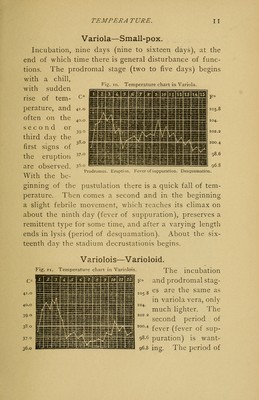
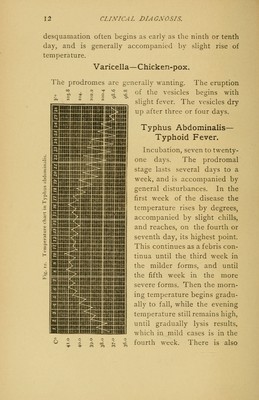
![Hyperpyrexia, or fever over 41.5° C. [106.7°]. Also in fever there is usually a morning remission and an evening exacerbation. Exceptionally, especially in phthisis, we have the reverse—typus inversus. The difference between the highest and lowest tempera- ture decides its type of the fever, thus : Febris co7itinua =■ a daily difference of not more than 1° C. [1.8° F.]. Febris remittens = a daily difference of not more than 1.5° C. [2.7° F.]. Febris intermittens = in the course of the dav the high temperature is varied by a period of no fever. In the course of a fever we distinguish : I. Stadium incrementi = a quick rise of temperature, generally accompanied by a chill or a slowly rising temperature, II. Fastigium rz: or a stage of highest temperature. Its transition to the next stage is known as the amphibolic stage. III. Stadium decrementi. The fever fall can follow either slowly, in course of several days, in which case we have lysis ; or quickly, the crisis. At the actual crisis the temperature falls rapidly (in one day) until it goes below normal. This fall is generally accompanied by a profuse perspiration. A high rise of temperature often precedes the crisis, which is called perturbatio critica. In acute infectious diseases we distinguish the stage of incubation—that is, the time between the moment of con- tagion and the outbreak of the disease. Also in acute exanthematous diseases there is the prodromal stage, or stage of the first morbid appearances, i. e., before the outbreak of the eruption.](https://iiif.wellcomecollection.org/image/b21207586_0027.jp2/full/800%2C/0/default.jpg)
 No text description is available for this image
 No text description is available for this image
 No text description is available for this image