Annual medical and sanitary report / Saint Vincent.
- Saint Vincent. Chief Medical Officer's Office.
- Date:
- [1931]
Licence: Attribution 4.0 International (CC BY 4.0)
Credit: Annual medical and sanitary report / Saint Vincent. Source: Wellcome Collection.
16/50 page 8
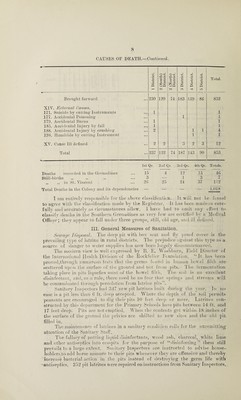
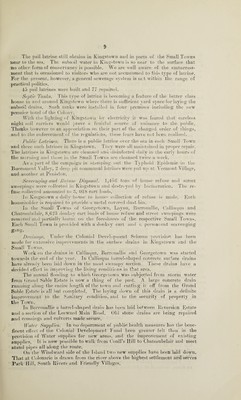
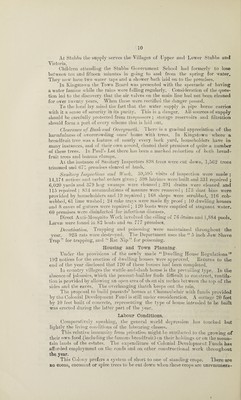
![CAUSES OF DEATH.—Continued. 1 District. 2 (South) District. 2 (North) District. 3 District. 4 District. 5 District. Total. Brought forward 230 120 74 183 1 39 8G 832 XIV. External Causes. 171. Suicide by cutting Instruments • • • 1 1 177. Accidental Poisoning • • . 1 1 179. Accidental Burns • . . 1 1 185. Accidental Injury by fall 1 1 188. Accidental Injury by crushing ... 2 1 1 4 198. Homicide by cutting Instrument ... 1 1 XV. Cause Ill defined ... 2 2 3 2 3 12 Total ... 237 122 74 187 143 90 853 1st Qr. 2nd Qr. 3rd Qr. 4th Qr. Totals. Deaths recorded in the Grenadines 15 4 12 15 4G Still-births ,, ,, 3 — 1 o 7 „ „ in St. Vincent 2G 25 24 37 112 Total Deaths in the Colony and its dependencies — — — — 1.018 I am entirely responsible for the above classification. It will not be found to agree witli the classification made by the Registrar. It lias been made as care¬ fully and accurately as circumstances allow. 1 have had to omit any effort to- classify deaths in the Southern Grenadines as very few are certified by a Medical Officer; they appear to fall under three groups, still, old age, and ill defined. III. General Measures of Sanitation. Sewatje Disposal. The deep pit with box seat and fly proof cover is the prevailing type of latrine in rural districts. The prejudice against this type as a source of danger to water supplies has now been largely discountenanced. The modern view is well expressed by ]>. E. Washburn, Field Director of the International Health Division of the Rockfeller Foundation. “It has been proved,through numerous tests that the germs found in human hovel filth are scattered upon the surface of the ground and not from pits. The fermentation taking place in pits liquefies most of the bowel filth. The soil is an excellent disinfectant, and, as a rule, there need be no fear that springs and streams will be contaminated through percolation from latrine pits”. Sanitary Inspectors had 347 new pit latrines built during the year. In no case is a pit less than G ft. deep accepted. Where the depth of the soil permits peasants are encouraged to dig their pits 10 feet deep or more. Latrines con¬ structed by this department for the Primary Schools have pits between 14 ft. and 17 feet deep. Pits arc not emptied. When the contents get within 18 inches of the surface of the ground the privies are shifted to new sites and the old pit filled in. The maintenance of latrines in a sanitary condition calls for the unremitting attention of the Sanitary Staff. The fallacy of putting liquid disinfectants, wood ash, charcoal, white lime and other antiseptics into cesspits for the purpose of “disinfecting’’ them still prevails to a large extent. Sanitary Inspectors are instructed to advise house¬ holders; to add horse manure to their pits whenever they are offensive and thereby increase bacterial action in the pits instead of destroying the germ life with -antiseptics. 252 pit latrines were repaired on instructions from Sanitary Inspectors.](https://iiif.wellcomecollection.org/image/b31497275_0016.jp2/full/800%2C/0/default.jpg)
 No text description is available for this image
 No text description is available for this image
 No text description is available for this image