Report for the year 1902 of the Medical Officer of Health.
- Holborn (London, England). Metropolitan Borough.
- Date:
- 1903
Licence: Attribution-NonCommercial 4.0 International (CC BY-NC 4.0)
Credit: Report for the year 1902 of the Medical Officer of Health. Source: Wellcome Collection.
35/64 page 35
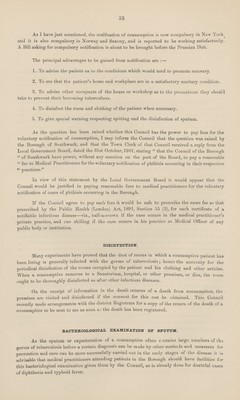
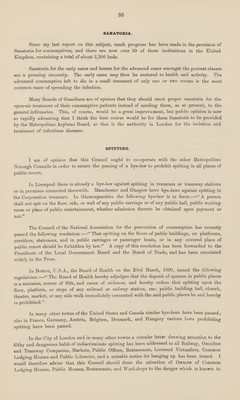
![35 As I have just mentioned, the notification of consumption is now compulsory in New York, and it is also compulsory in Norway and Saxony, and is reported to be working satisfactorily. A Bill asking for compulsory notification is about to be brought before the Prussian Diet. The principal advantages to be gained from notification are :— 1. To advise the patient as to the conditions which would tend to promote recovery. 2. To see that the patient's home and workplace are in a satisfactory sanitary condition. 3. To advise other occupants of the house or workshop as to the precautions they should take to prevent their becoming tuberculous. 4. To disinfect the room and clothing of the patient when necessary. 5. To give special warning respecting spitting and the disinfection of sputum. As the question has been raised whether this Council has the power to pay fees for the voluntary notification of consumption, I may inform the Council that the question was raised by the Borough of Southwark, and that the Town Clerk of that Council received a reply from the Local Government Board, dated the 31st October, ] 901, stating that the Council of the Borough of Southwark have power, without any sanction on the part of the Board, to pay a reasonable fee to Medical Practitioners for the voluntary notification of phthisis occurring in their respective practices. In view of this statement by the Local Government Board it would appear that the Council would be justified in paying reasonable fees to medical practitioners for the voluntary notification of cases of phthisis occurring in the Borough. If the Council agree to pay such fees it would be safe to prescribe the same fee as that prescribed by the Public Health (London) Act, 1891, Section 55 (3), for each certificate of a notifiable infectious disease—viz., half-a-crown if the case occurs in the medical practitioner's private practice, and one shilling if the case occurs in his practice as Medical Officer of any public body or institution. disinfection. Many experiments have proved that the dust of rooms in which a consumptive patient has been living is generally infected with the germs of tuberculosis; hence the necessity for the periodical disinfection of the rooms occupied by the patient and his clothing and other articles. When a consumptive removes to a Sanatorium, hospital, or other premises, or dies, the room ought to be thoroughly disinfected as after other infectious diseases. On the receipt of information in the death returns of a death from consumption, the premises are visited and disinfected if the consent for this can be obtained. This Council recently made arrangements with the district Registrars for a copy of the return of the death of a consumptive to be sent to me as soon as the death has been registered. bacteriological examination of sputum. As the sputum or expectoration of a consumptive often contains large numbers of the germs of tuberculosis before a certain diagnosis can be made by other methods and measures for prevention and cure can be more successfully carried out in the early stages ol the disease it is advisable that medical practitioners attending patients in the Borough should have facilities for this bacteriological examination given them by the Council, as is already done for doubtful cases of diphtheria and typhoid fever.](https://iiif.wellcomecollection.org/image/B18045091_0035.jp2/full/800%2C/0/default.jpg)