Volume 1
An account of the rise, progress, and decline of the fever lately epidemical in Ireland : together with communications from physicians in the provinces, and various official documents / by F. Barker and J. Cheyne.
- Date:
- 1821
Licence: Public Domain Mark
Credit: An account of the rise, progress, and decline of the fever lately epidemical in Ireland : together with communications from physicians in the provinces, and various official documents / by F. Barker and J. Cheyne. Source: Wellcome Collection.
Provider: This material has been provided by the Royal College of Physicians of Edinburgh. The original may be consulted at the Royal College of Physicians of Edinburgh.
30/530 (page 6)
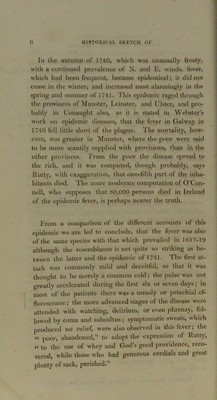
![In the autumn of 1740, which was unusually frosty, with a continued prevalence of N. and E. winds, fever, which had been frequent, became epidemical; it did not cease in the winter, and increased most alarmingly in the spring and summer of 1741. This epidemic raged through the provinces of Munster, Leinster, and Ulster, and pro- bably in Conaught also, as it is stated in Webster’s work on epidemic diseases, that the fever in Galway in 1740 fell little short of the ].)lague. The mortality, how- ever, was greater in Munster, where the poor were s(iid to be more scantily supplied with provisions, than in the other provinces. From the poor the disease spread to the rich, and it was computed, though probably, says Rutty, with exaggeration, that one-fifth part of the inha- bitants died. The more moderate computation of O’Con- nell, who supposes that 80,000 persons died in Ireland of the epidemic fever, is perhaps nearer the truth. From a comparison of the different accounts of this epidemic we are led to conclude, that tlie fever was also of the same species with that which prevailed in 1817-19 although the resemblance is not quite so striking as be- tween the latter and the epidemic of 1731. The first at- tack was commonly mild and deceitful, so that it was thought to be merely a common cold; the pulse was not greatly accelerated during the first six or seven days; in most of the patients there was a measly or petechial ef- florescence ; the more advanced stages of the disease were attended with watching, delirium, or even phrenzy, fol- lowed by coma and subsultus; symptomatic sweats, which pi'oduced no relief, were also observed in this fever; the “ poor, abandoned,” to adopt the expression of Rutty, to the use of whey and God’s good providence, reco- vered, while those who had generous cordials and great plenty of sack, perished.”](https://iiif.wellcomecollection.org/image/b28040855_0001_0030.jp2/full/800%2C/0/default.jpg)