Universal arithmetick: or, a treatise of arithmetical composition and resolution. To which is added, Dr. Halley's method of finding the roots of aequations arithmetically / Translated from the Latin by the late Mr. Raphson, and revised and corrected by Mr. Cunn.
- Newton, Isaac, 1642-1727. Arithmetica universalis. English
- Date:
- 1720
Licence: Public Domain Mark
Credit: Universal arithmetick: or, a treatise of arithmetical composition and resolution. To which is added, Dr. Halley's method of finding the roots of aequations arithmetically / Translated from the Latin by the late Mr. Raphson, and revised and corrected by Mr. Cunn. Source: Wellcome Collection.
281/310 page 251
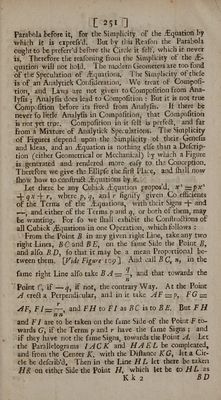
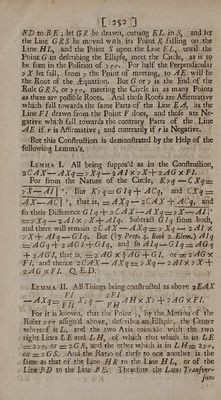
![Parabola before it, for the Simplicity of the /Equation by which it is exprefsd. But by this Reafon the Parabola ought to be preferr'd before the Circle it felf, which it never is, Therefore the reafoning from the Simplicity ‘of the /E- quation will not hold, The modern Geometers are too fond of the Speculation of /Equations, The Simplicity of thefe is of an Analytick Confideration, We treat of Compofi- tion, and Laws are not given to Compofition from Ana- lyfis ; Analyfis does lead to Compofition : But it is not true Compofition before its freed from Analyfis. If there be never fo little Analyfis in Compofition, that Compofition is not yet true. Compofition in it felt is perfect, and far from à Mixture of Analytick Speculations. The Simplicity of Figures depend upon the Simplicity, of. their, Genefis and Ideas, and an Aquation is nothing elfe than a Defcrip- tion (either Geometrical or Mechanical) by which a Figure is gentxated and: rendered. more: eafy to. the Conception, Therefore we give the Ellipfe the firft Place, and fhall now fhow how to conftru&t /Equations by.àt, - Let there be any Cubick /Equation proposd, x'-—px' +qx-tr, where p,q, andr fignify given. Co efficients of the Terms of the A:quations, with their Signs -]- and —, and either of the Terms p and g, or both of them, may be wanting. For fo we fhall exhibit the Conftructions of all Cubick Equations in one Operation, which follows : From the Point B in any given right Line, take any two right Lines, BC and BE, on the fame Side the Point B, and alfo B D, fo that it may be a mean Proportional be- tween them, [Vide Figure 109) And call BC, n, in the fame right Line alfo take B.A — 1 and that: towards the 5 ‘Point C, if — 4, if not, the contrary Way. At the Point A erect a. Perpendicular, aul in it take 4F —p, FG — AF, Fla, and FH to Fl as BC isto BE, But FH ‘and FJ are to be taken on the fame Side-of the Point F to- wards G; if the Terms p and r have the fame Signs; and -if they have not the fame Signs, towards the Point 4. Let the Parallelograms 1 4CK and HAE L be compleated, and from the Center K, with the Diftance KG, let.a Cir- cle be defcrib'd, Then in the Line H L let there be taken HR on either Side the Point H, which let be to HE as Kk 2 BD](https://iiif.wellcomecollection.org/image/b30538579_0281.jp2/full/800%2C/0/default.jpg)
 No text description is available for this image
 No text description is available for this image
 No text description is available for this image