Licence: Public Domain Mark
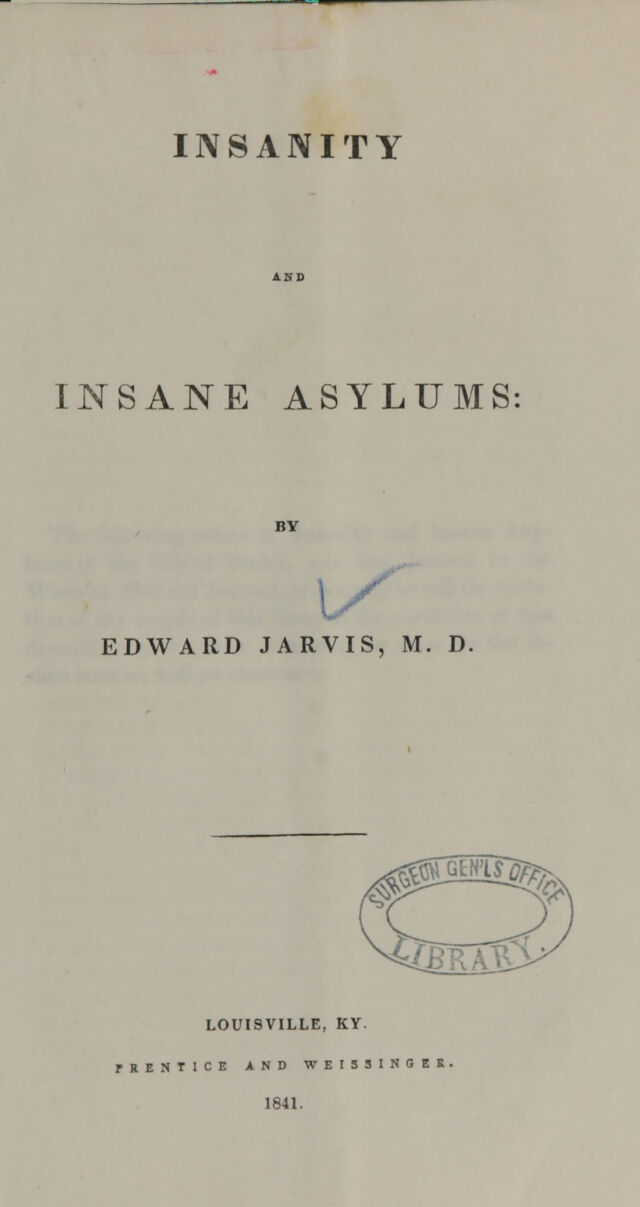
Credit: Insanity and insane asylums / by Edward Jarvis. Source: Wellcome Collection.
Provider: This material has been provided by the National Library of Medicine (U.S.), through the Medical Heritage Library. The original may be consulted at the National Library of Medicine (U.S.)
38/48
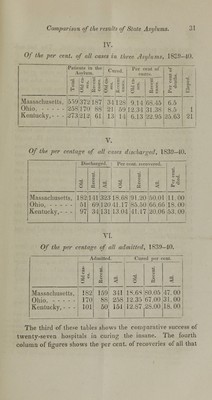
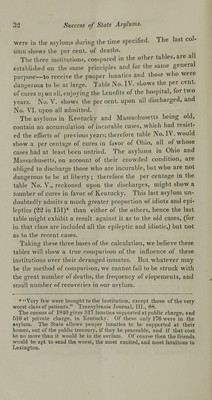
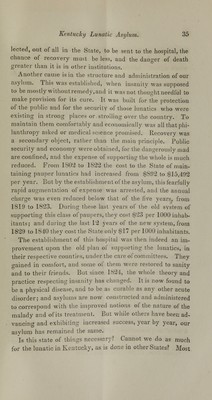
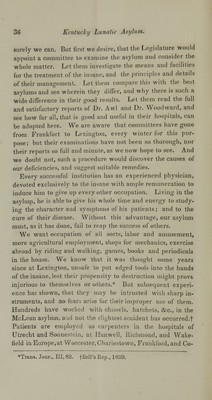
![were in the asylums during the time specified. The last col- umn shows the per cent, of deaths. The three institutions, compared in the other tables, are all established on the same principles and for the same general purpose—to receive the pauper lunatics and those who were dangerous to he at large. Table No. IV. shows the per cent. of cures u] on all, enjoying the Lenefits of the hospital, for two years. No. V. shows the percent, upon all discharged, and No. VI. upon all admitted. The asylums in Kentucky and Massachusetts being old, contain an accumulation of incurable cases, which had resist- ed the efforts of previous years; therefore table No. IV. would show a per centage of cures in favor of Ohio, all of whose cases had at least been untried. The asylums in Ohio and Massachusetts, on account of their crowded condition, are obliged to discharge those who are incurable, but who are not dangerous to be at liberty; therefore the per centage in the table No. V., reckoned upon the discharges, might show a number of cures in favor of Kentucky. This last asylum un- doubtedly admits a much greater proportion of idiots and epi- leptics (22 in 151)* than either of the others, hence the last table might exhibit a result against it as to the old cases, (for in that class are included all the epileptic and idiotic,) but not as to the recent cases. Taking these three bases of the calculation, we believe these tables will show a true comparison of the influence of these institutions over their deranged inmates. But whatever may be the method of comparison, we cannot fail to be struck with the great number of deaths, the frequency of elopements, and small number of recoveries in our asylum. * Very few were brought to the institution, except those of the very worst class of patients. Transylvania Journal, III., 68. The census of 1840 gives 317 lunatics supported at public charge, and 516 at private charge, in Kentucky. Of these only 176 were in the asylum. The State allows pauper lunatics to be supported at their homes, out of the public treasury, if they be peaceable, and if that cost be no more than it would be in the asylum. Of course then the friends would be apt to send the worst, the most excited, and most fatuitous to Lexington.](https://iiif.wellcomecollection.org/image/b21133037_0038.jp2/full/800%2C/0/default.jpg)
 No text description is available for this image
 No text description is available for this image
 No text description is available for this image