Report of the Royal Commission on the practice of subjecting live animals to experiments for scientific purposes : with minutes of evidence and appendix.
- Great Britain. Royal Commission on Vivisection
- Date:
- 1876
Licence: Public Domain Mark
Credit: Report of the Royal Commission on the practice of subjecting live animals to experiments for scientific purposes : with minutes of evidence and appendix. Source: Wellcome Collection.
Provider: This material has been provided by King’s College London. The original may be consulted at King’s College London.
381/450 (page 351)
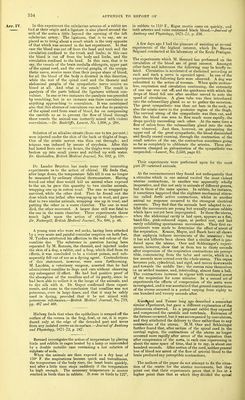
![APPENDIX IV. Aip.iv PEEEACE. It has been thought best to introduce this evidence by a description of apparatus required for operations written by Dr. Brunton, which corresponds with similar directions in the “ Handbook for the Physiological Laboratory,” edited by Dr. Burdon-Sanderson, and other handbooks. References are added to all extracts. If it be alleged that although the authors do not state it, the animals were nevertheless narcotised in some of the experiments, it maybe said in reply that no rule exists for the production of anaesthesia in laboratories except the operator’s conscience and his convenience in manipulation; and that vivisectors sometimes are of opinion that the presence of pain is preferable to the presence of a narcotic. It may also be added that when animals have to be narcotised the writers generally state such circumstance, and the omission, therefore, adds weight to the foregoing remarks. Even when used, a narcotic may be insufficient in quantity or ineffec^al in quality to prevent pain, although effective to permit of easier experimentation. The object may, moreover, be to deaden the sensory nerves during the cutting process only; and in such cases the animal awakens from its enforced sleep to the terrible consciousness of torture. Curare does not destroy pain, but only the power to express it. All these points must be remembered in reading the evidence. It is not expected that every one of the following quotations will pass without question; but it is assumed that the entire collection will present conclusive evidence that pain is very often inflicted by vivisectors, much of which is prolonged. The extracts are made from English books, and where the experiment was performed on the Continent it will be found that an English sanction has been given to it. Four divisions have been made, viz. :—(a.) Pain; {b.) Prolonged pain; (c.) Design to teach students vivisection; {d.) Opinions more or less against vivisection. A. EVIDENCE OF PAIN. A few of the following experiments may be said to show prolonged pain, especially in those of snake bites; but to prevent the mutilation of a consecutive series of experiments they have been retained under this head. Lectures on Experimental Investigation. Mode of securing Animals.—In order to determine in an exact manner what organs or parts are affected, we are obliged to make use of apparatus of various kinds; and before these can be applied to an animal it must be pre- vented from moving. Frogs are fastened to a frog-board by a piece of cord with a noose at the end, slipped over each elbow and ankle. The frog-board may consist of a piece of mill-board about nine inches long by three inches broad, with four slits at .the sides to keep the cords in position, or of a piece of wood the same size, and from a quarter to half an inch thick, with holes, through which the cords are passed. They may be fastened by simply tying them together, or by sticking a small wooden pin into each hole, or by four screws, such as are used by fastening the wires of galvanic batteries, placed in the edges of the hoard. The last way is, I think, the most con- venient. Rabbits are best seeured by Czermak’s holder and board. [Here follows drawing of Czermak’s holder, with the following key :—] (Czermak’s rabbit-holder and board.—A, the board. B, a bent piece of iron forming the upper part of the board. C, an open space through which instruments can be introduced from below to diAude the spinal cord. It is generally coA^ered by an iron plate. D is an upright rod fixed by a screw into a slit in B. F, is a forked rod, Avhich can be moved back or forward, up or doAvn, by the nut E. The forks are holloAv, so that the ends of the holder can be passed into them and fastened by the screAvy. H, is a bar which passes behind the incisor teeth of the rabbit. G and G are two bent bars Avhich pass under the chin and over the nose of the animal, and are brought together by the screw 1. From the upper end of g' hangs a screw, Avhich passes between two projections on g, and has a mother-screw K. The sereAV K works against the pro- jections on g, and draws the ends of g' and g together. These press on the rabbit’s nose and under jaw, and keep the teeth firmly locked over the rod li. M M are screAvs for fixing the cords which confine the legs. They are a remarkably convenient sort, consisting of an outer part with a horizontal hole, and an inner ring with a stalk, on Avhich a milled screw plays when the milled head is at the top of the stalk; the inner ring and outer holes correspond, and the cord can be easily pushed through ; but Avhen the milled head is turned, the stalk and ring are draAvn up and the cord nipped betAveen it and the outer part. The cords may either be fastened directly in the screAV, or passed first through one of the holes in the edge of the N board. The board should be covered with a large pad of india-rubber stuffed Avith horse-hair, and there should be another round pilloAV to put under the animal’s neck.) The best cord is strong AvindoAV cord. The one end should be flattened Avith a hammer, and turned over so as to make a small loop, Avhose tAvo sides are then firmly bound together Avith waxed thread. Through this loop, the other end is passed, and the noose thus made is ready to be drawn tight at any moment. The other end of the cord should be cut to a point, and. also bound Avith Avaxed thread, to prevent the strands unraA^elling. The rabbit is placed on the board, the nooses slipped over the legs and draAvn tight, and the ends of each cord passed through the scrcAv Avhich Avill be nearest it Avhen the animal lies on its back. The rabbit is then turned OA^er, and the cords draAvn through the screAvs and fastened. The bar h is then put between its teeth, and the scrcAV I turned till g and g' fit tightly over its muscle, and the projecting ends of g fixed into the ends of f. Dogs may be fastened by Bernard’s holder, [Here folloAvs draAAung of Bernard’s holder, Avith the following key:—] (A, is Bernard’s dog-holder.—a is a metal ring, within Avhich a bent piece of metal, b, is moved up and doAvn by the scrcAV c. A is a straight piece, Avhich is fastened by a screw to a, and can be moved nearer to or farther from a corresponding piece at b. These tAvo pieces lie under the loAver jaAV of the dog; the bent piece b is screwed down on its nose, and the strap i buckled behind its head, Avhich is thus firmly fixed. It may be moved back or forAvard by sliding the rod d through the nut c, or up and down by moving e on f, Avhich is a strong iron rod fastened to a table or board by the screAv g.) (B, Brunton’s holder for dogs or rabbits.—A loop of cord is tied round the upper jaw, the bar I passed behind the canine teeth of the dog or cat or incisors of the rabbit, and the two jaws then tied together to prevent its slipping out. This mode of fastening animals has been long used, and my modification simply consists in the addition of the forked bar h. After I is fastened in the mouth, the forked ends of k are pushed through holes in I, and fastened by the screws m. k may then be fastened to an upright bar by means of a nut in the same way as Bernard’s or Czermak’s holder.) or by a simple bar of iron put behind their canine teeth. A piece of cord is first tied round the upper jaw, the bar put into the mouth, and the tAvo jaws tied firmly oA^er it. A split strap may be used instead of the cord. I have had 4](https://iiif.wellcomecollection.org/image/b21302893_0381.jp2/full/800%2C/0/default.jpg)