Report of the Royal Commission on the practice of subjecting live animals to experiments for scientific purposes : with minutes of evidence and appendix.
- Great Britain. Royal Commission on Vivisection
- Date:
- 1876
Licence: Public Domain Mark
Credit: Report of the Royal Commission on the practice of subjecting live animals to experiments for scientific purposes : with minutes of evidence and appendix. Source: Wellcome Collection.
Provider: This material has been provided by King’s College London. The original may be consulted at King’s College London.
397/450 (page 367)
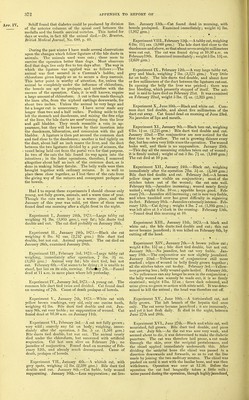
![3G7 Many other methods of resuscitation which have been recommended were practised, including actual cautery, venesection, cold splash, alternate application of hot and” cold water, galvanism, puncture of the diaphragm. [Twenty-six experiments under this head were tried, in which the animals were “ suffocated in the usual way by plugging their windpipes,” and the Committee add]— Although some of the above means were occasionally of manifest advantage, no one was of such unequivocal efficacy as to warrant the Committee in specially recom* mending its adoption.—Eeport of the Royal Humane Society, 1866, pp. 31-66. [Numerous experiments were also made on the bodies of deceased human beings which appear to have yielded excellent results. Reference to the Reports of the Royal Humane Society will show that with immaterial modifications the rnethod originally introduced to the Society by Dr. Silvester is still in use; such modifications having arisen out of experi- ments on dead human bodies alluded to, and were not derived from the foregoing painful experiments on animals.] experiments the “ ready method ” was established, he felt called upon for a few words in its defence. He regretted that the committee thought fit to condemn it, and observed that if the Marshall Hall method after all was a failure, the long series of experiments carefully made by him (Mr. Hunter) with others must go for nothing; and yet the original experiments were much more numerous than those made by this, committee, and perfectly conclusive in their general results to those who made and saw them. Dr. Williams would remark in reply to some objections made by Dr. Webster as to the destruction of animal life involved in these experiments that no one experiment had been undertaken mthout a definite and useful olqect; that animal suffering and life had been spared' as much as was possible in pursuing the inquiry; and he did not think that, when it was considered how animal life was hourly and unsparingly sacrificed for the gratification of appetite, there could be any objection to the dedication of a few lives to the elucidation of a subject of real importance to the interests of humanity.—Lancet, 2,028, p. 39-40. App. IV On the occasion of presenting the above Report to the Royal Medical and Chirurgical Society, the chairman of the investigating committee. Dr. Williams, closed his own summary of proceedings by saying :—“ So far then as these “ experiments go, they show a great superiority of Dr. Sil- “ vester’s over Dr. Marshall Hall’s ‘ ready method.’” Dr. Edward Smith remarked upon the great importance of the present discussion from the interest of the subject, and the fact this being the first occasion on which the society had appointed a committee to make scientific inves- tigation, it might be a precedent for future action. He thought it most desirable that the society should endeavour to accurately estimate the true value of the results which such committees could produce. On the present occasion they had a committee amongst whom were men of world- wide reputation, and a subject of inquiry of the highest interest, and not of greater complexity than would be found in all practical questions in medicine. The Report must be regarded in two aspects ; one that of the scientific facts which had been elicited; the other in their exact application to the purposes for which the committee was appointed—to determine the best methods of restoring the drowned. As to the facts, no one could doubt their extent and interest, the care with which they had been ascer- tained, and the pains taken to estimate the influence of disturbing causes ..... It was in reference to the practical object in the appoint- ment of the committee that the Report failed. The com- mittee had not proved that any one of their inquiries Was applicable to the drowned human subject. The time during which a man could be immersed in water and recover could not be proved by experiments on dogs, and the committee themselves had shown that all their plans for the restoration of drowned dogs had failed. The committee had in one part of the Rei^ort disclaimed any intention to say how far the Silvester method was fitted for the restoration of the drowned; and yet in their recom- mendations they advise the use of this method almost exclusively, without having in any experiment tried it, under these conditions. The recommendation to place the body prone and allow fluid to run out of the mouth, was an old recommendation; but they had inferred and not proved its value, and that only from experiments on drowned dogs which they could not resuscitate. The ex- periments on dogs had shown that neither hot nor cold water alone had any value as restorative agents, but that the alternative of the two was somewhat useful; but this alternative had not been recommended for man Dr. Webster said that he thought the Silvester method was the best, and that tlie recommendation was very im- portant. He was sorry to hear that the Lives of so many dogs had been sacrificed in the e.xperiments. He hoped that in future, if possible, experiments on living animals would be avoided ..... Mr. Charles Hunter said that as he was one of those gentlemen who six years ago conducted the experiments upon the dead body for Dr. Marshall Hall, and upon those [Other similar experiments were made by Dr. Waters, and the results communicated by Dr. Sharpey to the Royal Medical and Chirurgical Society, May 14th, 1861.] The subjects of experiments were dogs, cats, and rabbits. They were drowned in water varying in tem])erature from 40“ to 50“ Fahrenheit, and in one instance 56. On being removed from the water after every external symptom of life had disappeared, they were opened by the removal of the anterior part of the chest, so that the movement of the heart could be observed .... Thirteen experiments were pei’formed, twelve on rabbits, one on a cat. Of the thirteen, seven were put into the hot bath; of these six died at periods varying from two to twenty hours after submersion. Six animals were left t(j themselves; of these four recovered and two died, both between the eighth and twentieth hour after submersion. The author believes that the best method of performing artificial respiration we are acquainted with is that re-' commended by Dr. Marshall Hall. Dr. Babington was not sure whether experiments upon dogs respecting warm baths were applicable to human beings. The warm bath would probably be more injiu'ious to asphyxiated dogs from the fact that the skin of the dog was remarkably thick, and it was known that he did not perspire. He (,Dr. Babington) did not know whether cats were subject to perspiration. Dr. Waters in reply said that of the experiments he had detailed some were performed about four years ago. The attention of the profession was at that period directed to the subject by the late Dr. Marshall Hall. He (the author) at that time brought the results of his experiments in reference to the hot bath before the committee of the Liverpool Royal Humane Society. This society had pre- viously adopted the rules of the Royal Humane Society of London. The committee of the Liverpool Royal Humane Society referred his plan to the Liverpool Medical Society for their opinion. The result was that the plan was re- commended, and it was therefore adopted. Unfortunately no record whatever had been kept of the cases thus treated, so that no practical test of the working of the method was attainable The experiments of Mr. Erichsen and those performed by himself tended to prove that the heart contracted for some time after complete asphyxia.— Dr. Waters, Lancet, No. 1,969, p. 513 and 514. [After all these valuable experiments the learned Doctor comes to the following honest, sensible, conclusion.] In considering the question of the deviation of the heart’s beat in asphyxia, and the possibility of restoring ^imation in the affection, it is very desirable that if we err we should err on the right side. It‘is better that we should make fifty ineffectual attempts to save life, acting on the supposition of the prolonged duration of the heart’s beat, than that we should suffer one life to be lost by allowing the opposite assumption to paralyse our efforts.—Dr. Waters Lancet, No. 1,977, p. 60.](https://iiif.wellcomecollection.org/image/b21302893_0397.jp2/full/800%2C/0/default.jpg)