Report of the Royal Commission on the practice of subjecting live animals to experiments for scientific purposes : with minutes of evidence and appendix.
- Great Britain. Royal Commission on Vivisection
- Date:
- 1876
Licence: Public Domain Mark
Credit: Report of the Royal Commission on the practice of subjecting live animals to experiments for scientific purposes : with minutes of evidence and appendix. Source: Wellcome Collection.
Provider: This material has been provided by King’s College London. The original may be consulted at King’s College London.
398/450 (page 368)
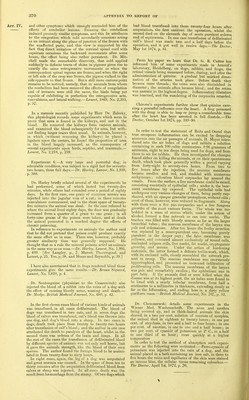
![App. IV. B. EVIDENCE 01 PROLONGED PAIN. i Some of the following show pain only for a short time, but they could not well be eliminated from the series in which ” they appear.] This pamphlet contains the results obtained by burning and scalding about thirty dogs, in regard to, 1st, the local temperature produced by burning certain substances upon the surface of the body; 2nd, the manner in which this local increase of temperature extends over neighbouring parts, and the mode in which this increased temperature dies off; 3rd, the histological alterations produced locally and generally by burns and scalds. Medium sized dogs alone were made use of. Some of these were narcotised by the injection of half a drachm of tincture of opium into the crural vein, and others by chloroform inhalations. ■The latter method was employed when the^blood was to be examined, the former in other cases. The Imrns were produced by sponging the chest and bellies of the dogs with oil of turpentine five or ten times in quick succession, setting fire to it each time, the scalds by pouring over similar parts eight ounces of boiling water mine times in quick succession. ■ , • The results obtained were :—1st, all the dogs died either in a few hours or at the latest after five days. 2nd. Excision of a jiortion of skin corresponding in position and extent to that burned, had no injurious effect on three dogs on which it was performed. For the first few days the wound was covered with sponge, no attention was subsequently paid them, and the wounds healed most kindly. 3rd. In three cases the burned portion of skin was excised two, five, and fourteen hours after the burning. All the three dogs died 24 hours after the burning.—Edm- burgli Medical Journal, 1868-9, p. 1026. To a third I gave 193 drops of spirits of wine within the hour, but warded off immediate death by means of strychnine. The. animal died in six weeks. On making the post-mortem examination, I found slight congestion of the dura mater, but severe congestion of the liver, which was black, and literally rotten. The intestine was also severely congested, doubtless in a great measure from the action of the strychnine, in this case a large amount of alcohol was kept in the blood of the rabbit by artificial means (equal to seven to eight pints in an ordinary sized man), 'i’he result was, that there was not oxygen avail- able to the extent required for its rapid conibustipn and elimination; hence the severe mischief set up by^ its presence.—Mr. Lucas, British Medical Journal, No. 724, p. 612. Good results are yielded more easily by a feverish than by a healthy animal. For these experiments strong guinea-pigs, rabbits, or dogs of the same origin and of the same quality have been used. Under their skin some cubic centimeter of ichor or putrifying blood was injected. After thus proceeding, the temperature of the animal rises several degrees, and all the symptoms appear which are to be observed in human beings suffering from putrid fever. If the quality of the poisonous substance be right the animal expires in a few days.—Nature, 216, p. 132. The author. Dr. Moritz Roth Greipwold, could not succeed in producing ulcers by tying or occluding vessels, but in a number of rabbits he produced ulcers, closely resembling the ordinary perforating ulcers, by adminis- tering a small fragment of lunar caustic, the ulcers were mostly along the lesser curvature and the back wall. When examined within a few days of the administration of the dose the surrounding mucous membrane was found swollen and inflamed.—Edinburgh Medical Journal, Yol. 18. p. 951. heavy enough to press it flat, but sufficiently small to allow the heart to be observed, and it was seen that the body was lifted during the contraction of the heart, but that during its extension it remained flat; and Dr. John Reid endorses the opinion as a legitimate deduction applicable to warm-blooded animals, and physi- ologists still continue to pursue their investigations in the action of the heart in cold-blooded animals. Page 412. We consider then that we have proceeded on sound physiological principles in the series of experiments that we instituted on the denuded heart of turtles during the highest temperature of the season, to determine the cause of the sounds of the heart; and we are decidedly of opinion that these animals afford a much better field for investigating the action of the heart and arriving at a correct knowledge of the cause of the sounds than is obtained from the denuded heart of warm-blooded animals. In the warm-blooded, as in the dog and ass, the operation of laying open the thorax and denuding the heart produces a great shock on the system, and the fact that you require to maintain artificial respiration to continue your investi- gations for any length of time, interferes materially rvith the action of the heart,, rendering it weak and irregular, and the sounds indistinctly heard. But in turtles the effect of the operation on the action of the denuded heart appears but slight. If the temperature of the body be high the heart con- tinues to pulsate with energy and in a normal and regular manner after being exposed, and the animal will survive for several days, affording an ample field to observe true action and investigate the cause of the sounds.—Dr. Eaton, Edinburgh Medical Journal, 1873-4, pp. 407-12. Who would have supposed that a rat’s tail after removal of the skin might be kept in a glass tube for 62 hours at 15-17° Fahr.; or kept for a still longer period in moist air at 121° Fahr.; or after being subjected to a temperature 31° below the freezing point; or, finally, after being dried in an air-pump over sulphuric acid, and enclosed in a glass tube for three days, then exposed to a temperature of 175° Fahr. in a hot air chamber, and again enclosed in a glass tube for four days,—who would have supposed that the unfortunate tail might be subjected to such a treatment and yet live on its being placed below the skin of the back of a rat. These remarkable facts regarding the vitality of the tissues have been ascertained. I had an opportunity of witnessing the results of two such experiments. [Amputating tails of animals and afterwards engrafting them on other animals.] In one the revived tail had been frozen; in the other it had been kept in moist air for three days at 121“ Fahr.; on the animals being injected it was found that there was free vascular communication between the engrafted tail and the sur- rounding tissues. He moreover finds that the tissues which have been subjected to such modifying influences are liable to fall into certain diseased conditions, the progress of which may be traced by killing the animal at different stages. In the prosecution of this research he is still engaged. He has also succeeded in joining together animals, not only of the same, but of different species, not not only rats to rats, but actually a rat to a cat. He effected this by denuding corresponding parts of their sides, and then uniting by means of sutures the skin of the one animal to that of the other, and tying the two animals together so as to prevent their tearing themselves apart. The practical importance of such researches does not require to be dwelt upon.—Dr. Rutherford, Journal of Anatomy and Fhysiology, 1867, p. 163. Physiologists have been accustomed to examine the action of the heart in cold-blooded animals to determine His investigations have extended over many years; the laws that regulate its movements. Dr. Hope performed and he has experimented upon cats, rabbits, crows, fowls, a number of experiments on frogs and on turtles, to pigeons, and various small birds. Of all these he finds perceive th 3 manner in which the auricle and ventricle young cats the best adajited for research, as the nerve contract and dilate; and Professor Muller, of Berlin, from trunks in those animals contain very little connective tissue the observations he made on the movement of the heart in in their interior. The mode of operating consisted either frogs, states a general law resiiecting tlie rhythm of the in dividing the nerve with the knife, or in applying a fine heart. Oesterreiclier placed a body on the heart of a frog silk ligature for a few moments, which is almost equally](https://iiif.wellcomecollection.org/image/b21302893_0398.jp2/full/800%2C/0/default.jpg)