Report of the Royal Commission on the practice of subjecting live animals to experiments for scientific purposes : with minutes of evidence and appendix.
- Great Britain. Royal Commission on Vivisection
- Date:
- 1876
Licence: Public Domain Mark
Credit: Report of the Royal Commission on the practice of subjecting live animals to experiments for scientific purposes : with minutes of evidence and appendix. Source: Wellcome Collection.
Provider: This material has been provided by King’s College London. The original may be consulted at King’s College London.
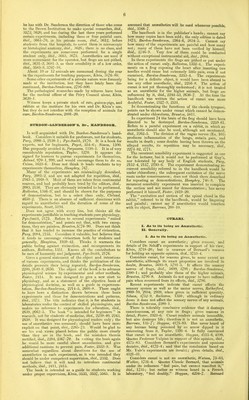
424/450 (page 6)
![he has with Dr. Sanderson the direction of those who come to the Brown Institution to make special researches, ibid., 3572, 3620, and has during the last three years performed certain experiments, including three or four painful ones, ibid., 3664-70, in his private room, ibid., 3612, before students from the hospitals, to assist them in microscopic or histological anatomy, ibid., 3626; there is no class, and the experiments are sometimes performed for a single student only, ibid., 3663, 3675. Anaesthetics are used if more convenient for the ojierator, but frogs are not pithed, ibid., 3631-3, 3681-3, as their sensibility is of a low order, ibid., 3583-9, 3707-16. About 10 or 12 animals are consumed during the year in the experiments for teaching purposes, Klein, 3676-80. Some other experiments of a private nature were formerly made at the institution, but they have lately been dis- continued, Burdon-Sanderson, 2796-800. The pathological researches made by witness have been for the medical ofBcer of the Privy Council alone, Klein, 3620-1. Witness keeps a private stock of rats, guinea-jiigs, and rabbits at the institute for his own and Dr. Klein’s use, but they do not interfere with the reception of animals for cure, Burdon-Sanderson, 2801-20. BVRDOir-SA.XT]>X:RSON’S, Dr., HANDBOOK. Is well acquainted with Dr. Burdon-Sanderson’s hand- book. Considers it suitable for professors, not for students, Pawy, 2080-5, 2150-1; Pye-Smitli,2\~(). It is a book for experts, not for beginners, Paget, 354-6; Simon, 1500. Has purposely avoided it, Fergusson, 1110-1. It is of very considerable reputation, Taylor, 1270. It appears de- signed for learners to iiursue experiments for themselves, Acland, 970-1, 999, and would encourage them to do so. Colam, 1623-6. Does not think it leads students to try experiments themselves, Humphry, 767. Many of the experim_ents are misleadingly described, Pavy, 2081-2, and are not adapted for repetition, ibid., 2163-5, 2168-9. Most of them are taken from continental sources, and had probably been tried by the editors, ibid., 2083, 2156. They are obviously intended to be performed, Rolleston, 1346-9,' and should be shown for the purposes of demonstration, but to a select class only, Cleland, 4650-2. There is an absence of sufficient directions with regard to anaesthetics and the duration of some of the experiments, Scott, 5194. Does not agree with every line, but thinks all the experiments justifiable in teaching students pure physiology, Pye-Smitk, 2175. Refers to several experiments “suited for demonstration,” and points out that, with two excep- tions, they are painless, Brunton, 5776-90. Does not think that it has tended to increase the practice of vivisection, Pavy, 2084, 2155. Considers it valuable, but believes that it tends to encourage vivisection both by students and generally, Haughton, 1939-42. Thinks it warrants the public feeling against vivisection, and misrepresents its authors, Rolleston, 1351. Knows all the contributors to be men of humanity and judgment, Pye-SmitJi, 2176. Gives a general statement of the object and intentions of various experiments, and thinks the publication of the details prevents their being repeated, Burdon-Sanderson, 2280, 2640-8,2650. The object of the boolc is to advance physiological science by experimental and other methods, Foster, 2414. It was designed to give a new start to physiology, and as a statement of the objective basis of physiological doctrine, as well as a guide in experimen- tation, Burdon-Sanderson, 2214-5, 2666-8. There ought to have been a distinction drawn between these basis experiments and those for demonstrations and patterns, ibid., 2372. The title indicates that it is for students in laboratories under the control of skilled physiologists, and makes no reference to e.xperiments for education, ibid., 2639, 2662-5. The book “ is intended for beginners ” in research, not for students of medicine, ibid., 2239^0, 2243, 2638. It was designed for physiological readers only; the use of anaesthetics was assumed; should have been more explicit on that point, ibid., 2265-73. Would be glad to see his real views placed before the public more clearly •than they are in the book, and the mistakes therein rectified, 2284, 2367-70- In vriting the book again he would be more careful about anaesthetics, and give additional cautions to prevent pain, Foster, 2333-9. Was somewhat regardless about directions for the use of anaesthetics in each experiment, as it was intended they should be under competent supervision, ibid., 2332. Does not believe that it will tend to introduce continental methods, ibid., 2411, 2415. The book is intended as a guide to students working under proper supervision, Klein, 3533, 3537, 3565. It is assumed that anaesthetics will be used whenever possible ibid., 3566-7. The handbook is in the publisher’s hands; cannot say how many copies have been sold; the only edition is dated 1873, Burdon-Sanderson, 2364-6, 2634-5. Cannot say how many of the experiments are painful and how many not; many of them have not been verified by himself, ibid., 2746-9. Very few of them could be conducted without exceptional instrumental aid, ibid., 2684. In these experiments the frogs are pithed or put under the action of curari only, Rolleston, 1352—4. The experi- ments on a frog exposing the heart after inserting two needles would cause but extremely little pain, even if not curarised, Burdon-Sanderson, 2253-4. The experiments being for a definite object, it would have been absurd to use any other anaesthetic, ibid., 2256-8. The action of curari is not yet thoroughly understood; it is not treated as an anaesthetic for the higher animals, but frogs are influenced by it, ibid., 2244-53, 2636-7. At the time the handbook was written the action of curari was more doubtful, Foster, 2327-9, 2331. In'demonstrating the functions of the chorda tympani, points can be shown under curari which cannot be demon- strated under chloroform, Brunton, 5811. In experiment 74 the brain of the frog should have been directed to be destroyed, Burdon-Sanderson, 2259-61. Refers to a painful experiment on a rabbit, in which an anaesthetic should also be used, although not mentioned, ibid., 2262-5. The division of the vagus nerves (Ex. 101) produces inflammation of the lungs, entails pain, and results in death ; some doubts having been thrown on the alleged results, its repetition may be necessary, ibid, 2274-82, 2771. The recurrent sensibility experiment is suggested as one for the lecturer, but it would not be performed at Guy’s, nor tolerated by any body of English students, Pavy, 2152-4, 2157, 2193-6. The experiment demonstrating re- current sensibility referred to in the handbook would be under chloroform; the subsequent excitation of the nerve roots under consciousness ; does not think them described for repeating as demonstrations, Humphry, 746-8. The recurrent sensibihty experiment was inserted to complete the section and not meant for demonstration; has never performed it himself, Foster, 2419-20. The “ e.xcitation and section of the spinal chord in the rabbit,” referred to in the handbook, would be lingering and painful; cannot say if anaesthetics would interfere with its object. Burrows, 208-10. CVKARX. X. As to its being; an Aneestiietic. XX. Generally. X. As to its being; an Anaesthetic. Considers curari an anaesthetic; gives reasons, and details of Dr. Schiff’s experiments in support of his view, Klein, 3718-20; but is unaware of Bernard’s reasons for holding an opposite opinion, ibid., 3753-4. Considers curari, for reasons given, to some extent an anaesthetic, although its e.xact properties are involved in doubt, Brunton, 5693-9, 5791-5. It affects the sensory nerves of frogs, ibid., 5699, 5791; Burdon-Sanderson, 2380-1; and probably also those of the higher animals, Brunton, 5796-8. Animals do not appear to have suffered pain when recovered from its effects, ibid., 5796. Recent experiments indicate that curari affects the sensory system as well as the motor nerves, Rutherford, 2909-10, 2.934, 2939, when given in sufficient quantity, Sibson, 4752-9, Rolleston, 1350; although in ordinary doses it does not affect the sensory nerves of any animals, Burdon-Sanderson, 2380-1. There is tolerably conclusive evidence that it destroys consciousness, at any rate in frogs; gives reasons m detail, Foster, 2323-6. Curari renders animals insensible, but also destroys life; therefore it is not an anaesthetic. Burrows, 135-7; Hoggan, 4175-83. Has never heard of any human being poisoned by an arrow dipped in it recovering from it, Taylor, 1191-4. Is fully convinced that curari is not an anaesthetic, Hoggan, 4115-6, 4199. Quotes Professor Vulpian in support of this opinion, ibid., 4175-83. Considers Bernard’s experiments and opinions decisive, 4172-4; and that the conclusion based on Mr. Yule’s experiments are invalid; gives details, ibid., 4121-31. Considers curari is not an anaesthetic, Watson, 75-83, Walker, 1731-4. Quotes Claude Bernard, that animals under its influence “ feel pain, but cannot manifest it,” ibid., 1735; but rather as witness heard in a French laboratory, “feel doubly,” Hoggan, 4234-7. Bernard](https://iiif.wellcomecollection.org/image/b21302893_0424.jp2/full/800%2C/0/default.jpg)