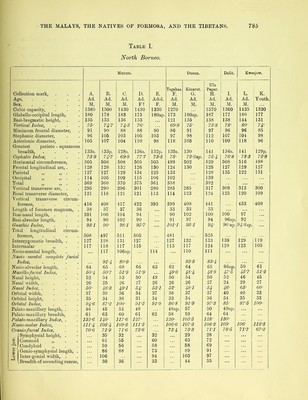
A contribution to the craniology of the natives of Borneo, the Malays, the natives of Formosa, and the Tibetans / by Sir William Turner.
- William Turner
- Date:
- 1907
Licence: In copyright
Credit: A contribution to the craniology of the natives of Borneo, the Malays, the natives of Formosa, and the Tibetans / by Sir William Turner. Source: Wellcome Collection.
Provider: This material has been provided by The Royal College of Surgeons of England. The original may be consulted at The Royal College of Surgeons of England.
9/52 (page 787)
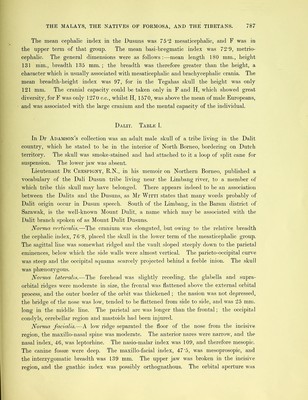
![The mean cephalic index in the Dusuns was 7 5'2 mesaticephalic, and F was in the upper term of that group. The mean basi-bregmatic index was 72’9, metrio- cephalic. The general dimensions were as follows:—mean length 180 mm., height 131 mm., breadth 135 mm. ; the breadth was therefore greater than the height, a character which is usually associated with mesaticephalic and brachycephalic crania. The mean breadth-height index was 97, for in the Tegahas skull the height was only 121 mm. The cranial capacity could be taken only in F and H, which showed great diversity, for F was only 1270 c.c., whilst H, 1570, was above the mean of male Europeans, and was associated with the large cranium and the mental capacity of the individual. Dalit. Table I. In Dr Adamson’s collection was an adult male skull of a tribe living in the Dalit country, which he stated to be in the interior of North Borneo, bordering on Dutch territory. The skull was smoke-stained and had attached to it a loop of split cane for suspension. The lower jaw was absent. Lieutenant De Ceespigny, K.N., in his memoir on Northern Borneo, published a vocabulary of the Dali Dusun tribe living near the Limbang river, to a member of which tribe this skull may have belonged. There appears indeed to be an association between the Dalits and the Dusuns, as Mr Witti states that many words probably of Dalit origin occur in Dusun speech. South of the Limbang, in the Baram district of Sarawak, is the well-known Mount Dulit, a name which may be associated with the Dalit branch spoken of as Mount Dulit Dusuns. Norma verticalis.—The cranium was elongated, but owing to the relative breadth the cephalic index, 76‘8, placed the skull in the lower term of the mesaticephalic group. The sagittal line was somewhat ridged and the vault sloped steeply down to the parietal eminences, below which the side walls were almost vertical. The parieto-occipital curve was steep and the occipital squama scarcely projected behind a feeble inion. The skul] was phsenozygous. Norma lateralis.—The forehead was slightly receding, the glabella and supra- orbital ridges were moderate in size, the frontal was flattened above the external orbital process, and the outer border of the orbit was thickened; the nasion was not depressed, the bridge of the nose was low, tended to be flattened from side to side, and was 25 mm. long in the middle line. The parietal arc was longer than the frontal; the occipital condyls, cerebellar region and mastoids had been injured. Norma facialis.—A low ridge separated the floor of the nose from the incisive region, the maxillo-nasal spine was moderate. The anterior nares were narrow, and the nasal index, 46, was leptorhine. The nasio-malar index was 109, and therefore mesopic. The canine fossae were deep. The maxillo-facial index, 47'5, was mesoprosopic, and the interzygomatic breadth was 139 mm. The upper jaw was broken in the incisive region, and the gnathic index was possibly orthognathous. The orbital aperture was](https://iiif.wellcomecollection.org/image/b22416857_0011.jp2/full/800%2C/0/default.jpg)