Copy 1
A course of lectures on dental physiology and surgery. Delivered at the Middlesex Hospital School of Medicine / [Sir John Tomes].
- John Tomes
- Date:
- 1848
Licence: Public Domain Mark
Credit: A course of lectures on dental physiology and surgery. Delivered at the Middlesex Hospital School of Medicine / [Sir John Tomes]. Source: Wellcome Collection.
27/422 (page 9)
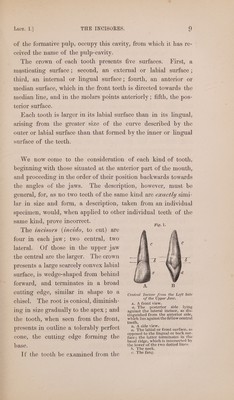
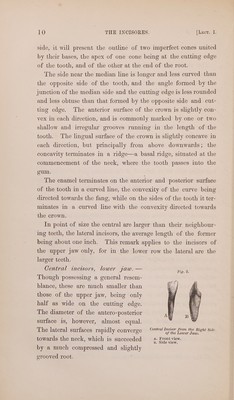
![Lyor. 1] THE INCISORES. 0) of the formative pulp, occupy this cavity, from which it has re- ceived the name of the pulp-cavity. The crown of each tooth presents five surfaces. First, a masticating surface; second, an external or labial surface ; third, an internal or lingual surface; fourth, an anterior or median surface, which in the front teeth is directed towards the median line, and in the molars points anteriorly ; fifth, the pos- terior surface. Each tooth is larger in its labial surface than in its lingual, arising from the greater size of the curve described by the outer or labial surface than that formed by the inner or lingual surface of the teeth. We now come to the consideration of each kind of tooth, beginning with those situated at the anterior part of the mouth, and proceeding in the order of their position backwards towards the angles of the jaws. The description, however, must be general, for, as no two teeth of the same kind are exactly sim1- lar in size and form, a description, taken from an individual specimen, would, when applied to other individual teeth of the same kind, prove incorrect. The incisors (incido, to cut) are four in each jaw; two central, two lateral. Of those in the upper jaw the central are the larger. The crown presents a large scarcely convex labial surface, is wedge-shaped from behind forward, and terminates in a broad cutting edge, similar ue shape to a Central Incisor from the Left Side of the Upper Jaw. A. ae view. ee : s = 2 Zs a. The posterior side lying ng in $1Ze gt adually to the apex 2 and against the lateral incisor, as dis- tinguished from the anterior side, the tooth, when seen from the front, pies lies against the fellow central tooth. presents in outline a? tolerably periect . ? tec tabiet or front surface, as : : opposed to the lingual or back sur- cone, the cutting edge forming the fice: the latter terminates in the basal ridge, which is intersected by base. the lower of the two dotted lines. b. The neek. If the tooth be examined from the — “ The fan chisel. ‘The root is conical, diminish-](https://iiif.wellcomecollection.org/image/b33098463_0001_0027.jp2/full/800%2C/0/default.jpg)