4-L-methylaminoethylglyoxaline / by Robert George Fargher and Frank Lee Pyman.
- Fargher, Robert George.
- Date:
- [1921?]
Licence: In copyright
Credit: 4-L-methylaminoethylglyoxaline / by Robert George Fargher and Frank Lee Pyman. Source: Wellcome Collection.
2/8 page 735
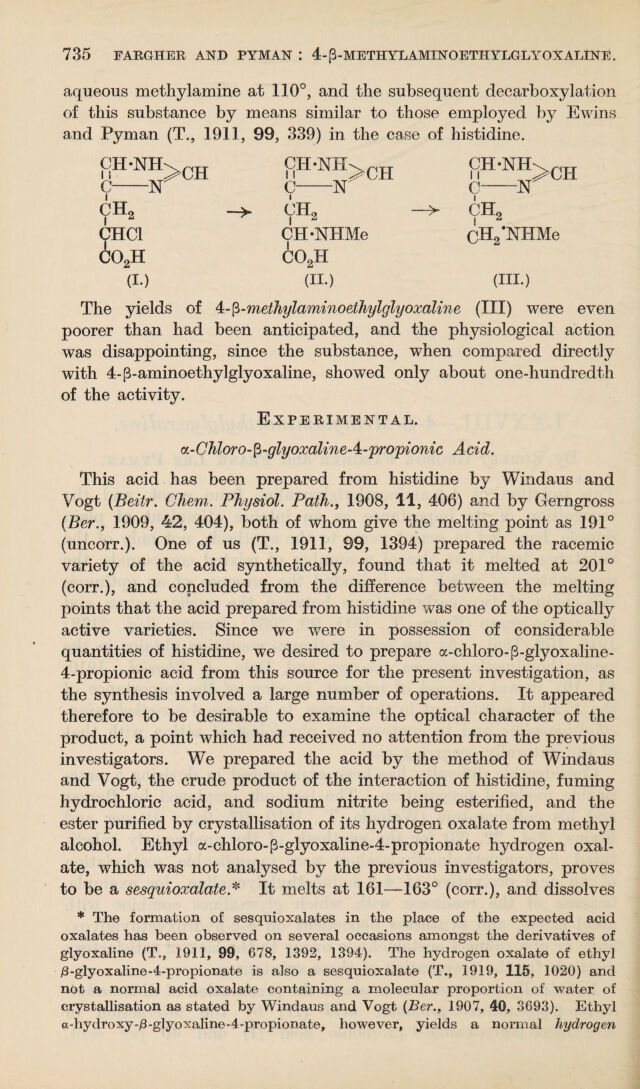
![aqueous methylamine at 110°, and the subsequent decarboxylation of this substance by means similar to those employed by Ewins and Pyman (T., 1911, 99, 339) in the case of histidine. C-N CH2 CHC1 C02H (I.) CH-NH C-N VH2 CH*NHMe C02H (II.) > ch-nh>ch C-N CH2 CH2*NHMe (III.) The yields of 4t-$-methylaminoethylglyoxaline (III) were even poorer than had been anticipated, and the physiological action was disappointing, since the substance, when compared directly with 4- p-aminoethy]glyoxaline, showed only about one-hundredth of the activity. Experimental. a-Chloro-fi-glyoxalineA-propionic Acid. This acid has been prepared from histidine by Wiiidaus and Vogt (Beitr. Chem. Physiol. Path., 1908, 11, 406) and by Gerngross (Ber., 1909, 42, 404), both of whom give the melting point as 191° (uncorr.). One of us (T., 1911, 99, 1394) prepared the racemic variety of the acid synthetically, found that it melted at 201° (corr.), and concluded from the difference between the melting points that the acid prepared from histidine was one of the optically active varieties. Since we were in possession of considerable quantities of histidine, we desired to prepare a-chloro-p-glyoxaline- 4-propionic acid from this source for the present investigation, as the synthesis involved a large number of operations. It appeared therefore to be desirable to examine the optical character of the product, a point which had received no attention from the previous investigators. We prepared the acid by the method of Windaus and Vogt, the crude product of the interaction of histidine, fuming hydrochloric acid, and sodium nitrite being esterified, and the ester purified by crystallisation of its hydrogen oxalate from methyl alcohol. Ethyl a-chloro-P-glyoxaline-4-propionate hydrogen oxal¬ ate, which was not analysed by the previous investigators, proves to be a sesquioxalate* It melts at 161—163° (corr.), and dissolves * The formation of sesquioxalates in the place of the expected acid oxalates has been observed on several occasions amongst the derivatives of glyoxaline (T., 1911, 99, 678, 1392, 1394). The hydrogen oxalate of ethyl j8-glyoxaline-4-propionate is also a sesquioxalate (T., 1919, 115, 1020) and not a normal acid oxalate containing a molecular proportion of water of crystallisation as stated by Windaus and Vogt (Ber., 1907, 40, 3693). Ethyl a-hydroxy-/3-glyoxaline-4-propionate, however, yields a normal hydrogen](https://iiif.wellcomecollection.org/image/b3062292x_0002.jp2/full/800%2C/0/default.jpg)