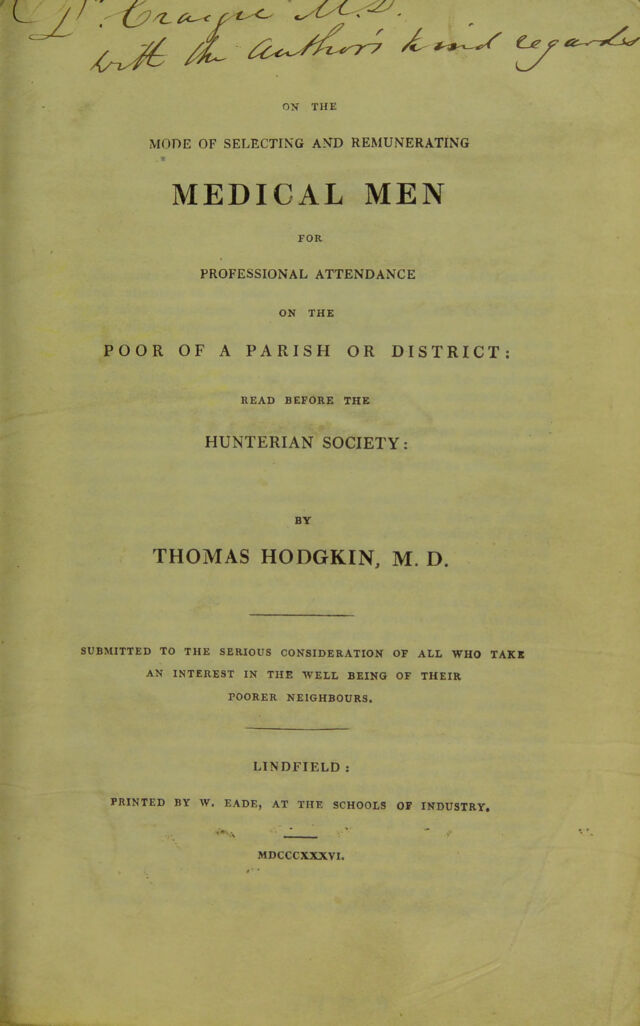
On the mode of selecting and remunerating medical men for professional attendance on the poor of a parish or district : read before the Hunterian Society / by Thomas Hodgkin.
- Date:
- 1836
Licence: Public Domain Mark
Credit: On the mode of selecting and remunerating medical men for professional attendance on the poor of a parish or district : read before the Hunterian Society / by Thomas Hodgkin. Source: Wellcome Collection.
Provider: This material has been provided by the Royal College of Physicians of Edinburgh. The original may be consulted at the Royal College of Physicians of Edinburgh.
4/16 page 4
![appointment, nil] be satisfied to make so great a sacrifice for the good, of tlie public. It is only reasonable to suppose, that there must be a strong inducement on bis part, ns soon as his eyes are opened to the injurious bargain which he has made, to reduce, as ne.uly as possible, to the minimum, the amount of time and medicine b( stoned ; and ( very one whether in the medical profession or not, l‘° ’s 5,1 *d 1 acquainted with the nature of medical advice, must be* veil aware of ilie impossibility of finding any definite line, by which the justifiable minimum of attention and medicine can be marked out. for the non-professional public to be fully aware of the evils of this mode of obtaining parish medical advice, it may be well to illustrate the subject by a few examples. The first example which 1 shall cite, is one in which both the medical man, and the public cm] Joying him, may perceive the least room to object. A medical man in large practice and high reputation, continues to attend a parish for a trifling sum, partly because be does not wish a rival to obtain ar. office, which he may conceive may render him mote for- midable, but principally to give practice to young men, with whom he may have received good apprentice fees. He may reconcile this to bis ccnsc.ence by thinking that if he keep the young men atten- tive to their duty, his poor fellow parishioners will be at least as well attended to as the poor of many other parishes, and that they may have the advantage of bis own superior advice whenever a serious or difficult case occurs. The public however is not properly- served, since in most cases the contractor himself is only nominally concerned, and the custom of allow ing apprentices to practise upon the poor of the parish, seems too much like making the Experiment tum in corport vili. There can be no doubt, that serious evils may arise from this practice. Symptoms may be misunderstood, and coming danger may not be perceived. When at last it is recognised, and the ostensible medical man is ultimately called in, it may be too late to administer relief. The public suffers in another way from this premature practice of apprentices, who until they have attended some medical school, can scarcely be said to have commenced their professional education. These young men are in great danger of becoming entangled in the trammels of routine or empirical practice, which will interfere with their future studies, and from which their future acquirements may not always extricate them. The public is therefore injured through this influence, exerted on the rising mem- bers of the medical profession. Sometimes the contractor does not delegate his.duty to young and unexperienced hands, but finding bis parish duties more extensive and oppressive than is consistent with the small sum lie receives, and probably feeling bound to pay the greater attention to bis private practice, on which depends his subsis- tence, he endeavours to reduce his parish labours to the smallest amount. The condition of patients, especially if they have been seen already, is frequently judged of by reports, and these reports](https://iiif.wellcomecollection.org/image/b21955086_0006.jp2/full/800%2C/0/default.jpg)