Appraisal of air pollution in Tennessee : report of a cooperative survey by the U.S. Public Health Service and the State of Tennessee Dept. of Public Health, December 1956-July 1957 / Paul A. Kenline, senior assistant sanitary engineer.
- United States Public Health Service
- Date:
- 1957
Licence: Public Domain Mark
Credit: Appraisal of air pollution in Tennessee : report of a cooperative survey by the U.S. Public Health Service and the State of Tennessee Dept. of Public Health, December 1956-July 1957 / Paul A. Kenline, senior assistant sanitary engineer. Source: Wellcome Collection.
72/96 page 64
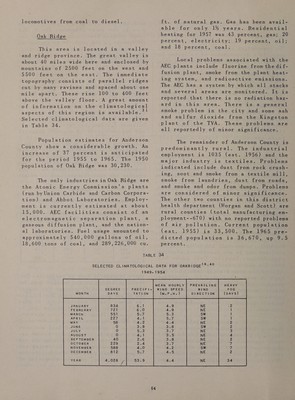
![locomotives from coal to diesel. Oak Ridge This area is located in a valley and ridge province. The great valley is about 40 miles wide here and enclosed by mountains of 2500 feet on the west and 9500 feet on the east. The immediate topography consists of parallel ridges cut by many ravines and spaced about one mile apart. These rise 100 to 400 feet above the valley floor. A great amount of information on the climatological aspects of this region is available. Selected climatological data are given in Table 34. Population estimates for Anderson County show a considerable growth. An increase of 37 percent is anticipated for the period 1955 to 1965. The, 1950 population of Oak Ridge was 30,230. The only industries in Oak Ridge are the Atomic Energy Commission’s plants (run by Union Carbide and Carbon Corpora- tion) and Abbot Laboratories. Employ- ment is currently estimated at about 15,000... AECWfacilities,consi st..of, dan electromagnetic separation plant, a gaseous diffusion plant, and the nation- al laboratories. Fuel usage amounted to approximately 540,000 gallons of oil, 18,600 tons of coal, and 289,226,000 cu. ft. of natural gas. Gas has been avail- able for only 1% years. Residential heating for 1957 was 43 percent, gas; 20 percent, electricity; 19 percent, oil; and 18 percent, coal. . Local problems associated with the AEC plants include fluorine from the dif- fusion plant, smoke from the plant heat- ing system, and radioactive emissions. The AEC has a system by which all stacks and several areas are monitored. It is reported that there is no radiation haz- ard in this area. There is a general smoke problem in the city and some ash and sulfur dioxide from the Kingston plant of the TVA. These problems are all reportedly of minor significance. The remainder of Anderson County is predominantly rural. The industrial employment is 1035 (est. 1956) and the major industry is textiles. Problems indicated include dust from rock crush- ing, soot and smoke from a textile mill, smoke from laundries, dust from roads, and smoke and odor from dumps. Problems are considered of minor significance. The other two counties in this district health department (Morgan and Scott) are rural counties (total manufacturing em- ployment--670) with no reported problems of air pollution. Current population (est. 1955) is 33,500. .The 1965 pre dicted population. i1s,36; 6/0 jeupeoeee percent. 16,40 TATION JANUARY FEBRUARY MARCH APRIL MAY JUNE JULY AUGUST SEPTEMBER OCTOBER NOVEMBER DECEMBER MNENNAUNWERDRUAAD NOBQD—-WON—]-NO— 64 PREVAILING WIND DIRECTION (M.ePeH.) (DAYS) b RAWWWWWAUUDA UNIX®MYM®aAYNWOO NUNN RUWNN]= ==](https://iiif.wellcomecollection.org/image/b32175735_0072.jp2/full/800%2C/0/default.jpg)