A system of midwifery : including the diseases of pregnancy and the puerperal state / by William Leishman.
- William Leishman
- Date:
- 1876
Licence: Public Domain Mark
Credit: A system of midwifery : including the diseases of pregnancy and the puerperal state / by William Leishman. Source: Wellcome Collection.
832/882 page 802
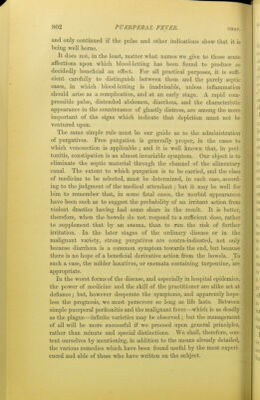
![and only continued if the pulse and other indications show that it is being well borne. It does not, in the least, matter what names we give to those acute affections upon which blood-letting has been found to produce so decidedly beneficial an effect. For all practical purposes, it is suffi- cient carefully to distinguish between them and the purely septic cases, in which blood-letting is inadvisable, unless inflammation should arise as a complication, and at an early stage. A rapid com- pressible pulse, distended abdomen, diarrhoea, and the characteristic appearance in the countenance of ghastly distress, are among the more important of the signs which indicate that depletion must not be ventured upon. The same simple rule must be our guide as to the administration of purgatives. Free purgation is generally proper, in the cases to Avhich venesection is applicable ; and it is well known that, in peri- tonitis, constipation is an almost invariable symptom. Our object is to eliminate the septic material through the channel of the alimentary canal. The extent to which purgation is to be carried, and the class of medicine to be selected, must be determined, in each case, accord- ing to the judgment of the medical attendant; but it may be well for him to remember that, in some fatal cases, the morbid appearances have been such as to suggest the probability of an irritant action from violent drastics having had some share in the result. It is better, therefore, when the bowels do not respond to a sufficient dose, rather to supplement that by an enema, than to run the risk of further irritation. In the later stages of the ordinary disease or in the malignant variety, strong purgatives are contra-indicated, not only because diarrhoea is a common symptom towards the end, but because there is no hope of a beneficial derivative action from the bowels. To : such a case, the milder laxatives, or enemata containing turpentine, are appropriate. In the worst forms of the disease, and especially in hospital epidemics, the power of medicine and the skill of the practitioner are alike set at defiance; but, however desj)erate the symptoms, and apparently hope- less the prognosis, we must persevere so long as life lasts. Between simple puerperal peritonitis and the malignant fever—which is as deadly as the plague—infinite varieties may be observed; but the management of all will be more successful if we proceed upon general principles, rather than minute and special distinctions. We shall, therefore, con- j tent ourselves by mentioning, in addition to the means already detailed, ] the various remedies which have been found useful by the most experi- enced and able of those who have written on the subject.](https://iiif.wellcomecollection.org/image/b20388792_0832.jp2/full/800%2C/0/default.jpg)