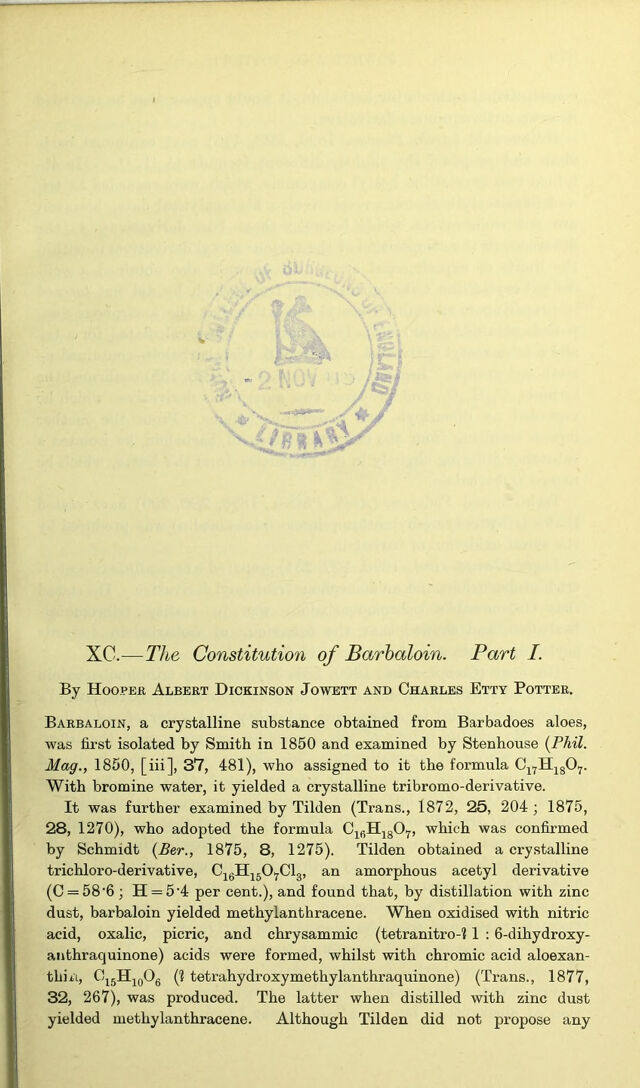
The constitution of barbaloin. Pt. I / by H.A.D. Jowett and Charles E. Potter.
- Jowett, Hooper Albert Dickinson, 1870-1936.
- Date:
- [1905]
Licence: Attribution 4.0 International (CC BY 4.0)
Credit: The constitution of barbaloin. Pt. I / by H.A.D. Jowett and Charles E. Potter. Source: Wellcome Collection.
Provider: This material has been provided by The Royal College of Surgeons of England. The original may be consulted at The Royal College of Surgeons of England.
5/12 page 880
![604) he has shown that by the action of chromic acid on aloe-emodin a substance was formed identical with Hesse’s rhein, a tetrahydroxy- methylanthraquinone isolated from rhubarb. He further showed that aloexanthin was really an impure rliein, and that Tilden’s views as to its constitution were correct. Seel (Ber., 1900, 33, 3212) gave the results of the oxidation of barbaloin with various reagents, but he was unable to isolate any definite product. With Caro’s acid, he obtained tetrah ydroxy methyl- anthraquinone. Leger (Compt. rend., 1902, 134, 1111, 1584) stated that by the action of sodium peroxide on barbaloin, formic acid and an aldopentose were formed, in addition to aloe-emodin. He therefore proposed to alter the empirical formula of barbaloin from C16H1607 to O21H20O9, and suggested the following constitutional formula :— OH I Lco-I ' ' HO\/ \/CH3 0-CH-'[CH-0H]3-CH0 ch3 Barbaloin was thus regarded by Leger as a new type of glucoside which is not hydrolysed by dilute acids. The evidence adduced in suj^portof this radical change in the formula of barbaloin is by no means conclusive. No analytical proof is given in support of this change, and the analytical data given in Leger’s first paper (loc. cit) agree much better with the old than with the new formula. The most important evidence, namely, the molecular weight of the substance or a closely related derivative, is lacking, but the molecular weight of a crystalline substance formerly described as triacetyltrichlorobarbaloin and now regarded as penta-acetyltetrachloro- barbaloin, is given. Unfortunately, the details of the experiment are not recorded. No detailed evidence is furnished of the identification of the sugar formed, and it is merely stated that a lsevorotatory syrup was obtained giving all the reactions of an aldopentose. In a later paper (J. Pharm. Chim., 1904, [vi], 20, 145), Leger attempted to obtain further proof of the presence of the sugar, which be has named aloinose, and indicated that he obtained a crystalline osazone which, however, does not appear to have been actually isolated or examined. Aschan (Arch. Pharm., 1903, 241, 341) made a number of analyses of carefully purified barbaloin, free from isobarbaloin, and also some molecular weight determination of barbaloin by the boiling point method, using acetone as the solvent; his results confirm the old formula, either CjcH1607 or C16H1S07.](https://iiif.wellcomecollection.org/image/b22401842_0007.jp2/full/800%2C/0/default.jpg)