The constitution of barbaloin. Pt. I / by H.A.D. Jowett and Charles E. Potter.
- Jowett, Hooper Albert Dickinson, 1870-1936.
- Date:
- [1905]
Licence: Attribution 4.0 International (CC BY 4.0)
Credit: The constitution of barbaloin. Pt. I / by H.A.D. Jowett and Charles E. Potter. Source: Wellcome Collection.
Provider: This material has been provided by The Royal College of Surgeons of England. The original may be consulted at The Royal College of Surgeons of England.
6/12 page 881
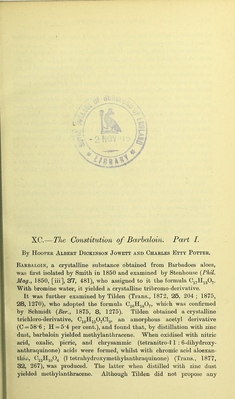
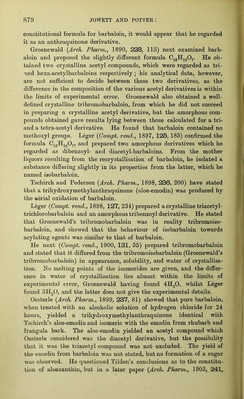
![In view of the conflicting statements made regarding barbaloin, and especially in view of Leger’s results, we commenced an inquiry into this subject. As our cooperation in this work has been interrupted, it has seemed desirable to publish the results thus far obtained, and the work will be continued by one of us. The results of numerous analyses and of two molecular weight determinations of carefully purified barbaloin have confirmed the formula, C1GH1807, first proposed by Tilden, although the analytical results are not very different from those required for Groenewald’s formula. As our results agree best on the whole for the formula C10H18O7, we shall for the present adopt it. This formula is also supported by the analysis and molecular weight determination of tribromobarbaloin. Leger’s conclusions, with regard to the formula C21H20O9 recently pro- posed by him and as to the constitution of barbaloin, must therefore be abandoned. We have carefully repeated Leger’s experiments on the formation of aloe-emodin by the action of sodium peroxide on barbaloin, but although the conditions were varied, no aloe-emodin could be isolated. On the other hand, Oesterle’s experiments on the action of hydrogen chloride in alcohol on barbaloin and the formation of aloe-emodin were confirmed, but the yield of the latter was very small and this line of inquiry was abandoned. Our next experiments were made with tribromobarbaloin from which a well-defined, crystalline tetra-acetyl derivative was obtained. Tribromobarbaloin, and probably barbaloin, therefore contains four hydroxyl groups. Both these substances yield methylanthracene by distillation with zinc dust. Whilst we are unable at this stage of the inquiry to offer any suggestions as to the constitutional formula of barbaloin, we wish to point out that the generally accepted view that it contains an emodin (trihydroxymethylanthraquinone) complex is open to serious objection. If it contains this complex, the formula may be written {[C14H402(CH3)(0H)3]CH70(0H)}, and it is difficult to see how so many hydrogen atoms as are contained in the complex CH70 can be introduced into any possible formula. On the other hand, the formation of small amounts of emodin and other anthracene derivatives renders it probable that it bears some relation to this parent substance. It is possible that it is not a derivative of methylanthracene, but of a reduced anthracene, thus accounting for the large amount of hydrogen contained in the substance.](https://iiif.wellcomecollection.org/image/b22401842_0008.jp2/full/800%2C/0/default.jpg)