Evils of the factory system demonstrated by parliamentary evidence / by Charles Wing.
- Wing Charles, -1869.
- Date:
- 1837
Licence: Public Domain Mark
Credit: Evils of the factory system demonstrated by parliamentary evidence / by Charles Wing. Source: Wellcome Collection.
Provider: This material has been provided by the Royal College of Physicians of Edinburgh. The original may be consulted at the Royal College of Physicians of Edinburgh.
101/706
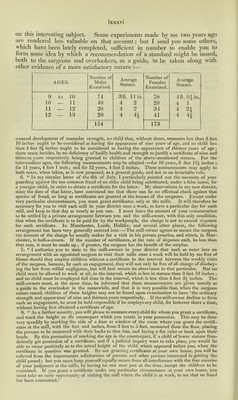
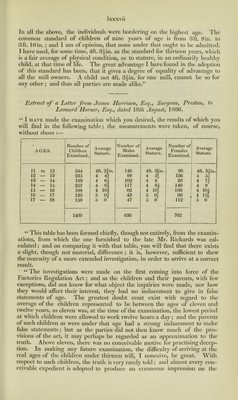
![In all the above, the individuals were bordering on the highest age. The common standard of children of nine years of age is from 3ft. 9in. to 3 ft. lOin.; and I am of opinion, that none under that ought to be admitted. I have used, for some time, 4ft. 3Jin. as the standard for thirteen years, which is a fair average of physical condition, as to stature, in an ordinarily healthy child, at that time of life. The great advantage I have found in the adoption of this standard has been, that it gives a degree of equality of advantage to all the mill owners. A child not 4ft. 3Jin. for one mill, cannot be so for any other; and thus all parties are made alike.” jExtract of a Letter from James Harrison, Esq,, Surgeon, Preston, to Leonard Horner, Esq., dated 16th August, 1836. “ I have made the examination which you desired, the results of which you will find in the following table; the measurements were taken, of course, without shoes :— AGES. Number of Children Examined. Average Stature. Number of Males Examined. Average Stature. Number of Females Examined. Average Stature. 11 to 12 244 4ft. 2fin. 4 146 4ft. 2§in. s] 98 4ft. 34in. 12 — 13 235 4 99 4 136 4 5* 13 — 14 193 4 6t 8§ 102 4 6 20 4 7£ 14 — 15 257 4 117 4 8 j 140 4 9 15 — 16 188 4 10f 82 4 10i 106 4 10| 16 — 17 133 5 Of 43 5 oi 90 4 IR 17 — 18 159 5 0 47 5 0 112 5 0 1409 636 702 66 This table has been formed chiefly, though not entirely, from the examin- ations, from which the one furnished to the late Mr. Rickards was cal- culated ; and on comparing it with that table, you will find that there exists a slight, though not material, difference; it is, however, sufficient to shew the necessity of a more extended investigation, in order to arrive at a correct result. “ The investigations were made on the first coming into force of the Factories Regulation Act; and as the children and their parents, v itli few exceptions, did not know for what object the inquiries were made, nor how they would affect their interest, they had no inducement to give in false statements of age. The greatest doubt must exist with regard to the average of the children represented to be between the ages of eleven and twelve years, as eleven was, at the time of the examination, the lowest period at which children were allowed to work twelve hours a day ; and the parents of such children as were under that age had a strong inducement to make false statements; but as the parties did not then know much of the pro- visions of the act, it may perhaps be regarded as an approximation to the truth. Above eleven, there was no conceivable motive for practising decep- tion. In making any future examination, the difficulty of arriving at the real ages of the children under thirteen will, I conceive, be great. With respect to such children, the truth is very rarely told ; and almost every con- ceivable expedient is adopted to produce an erroneous impression on the](https://iiif.wellcomecollection.org/image/b21729827_0101.jp2/full/800%2C/0/default.jpg)