[Reports and Appendices] of the Irish Milk Commission, 1911.
- Great Britain. [Royal] Commission on the Irish Milk Supply.
- Date:
- 1913
Licence: In copyright
Credit: [Reports and Appendices] of the Irish Milk Commission, 1911. Source: Wellcome Collection.
Provider: This material has been provided by London School of Hygiene & Tropical Medicine Library & Archives Service. The original may be consulted at London School of Hygiene & Tropical Medicine Library & Archives Service.
1053/1108 (page 171)
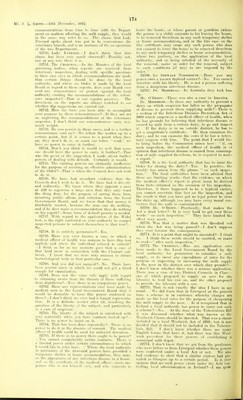
![Mr. J. L. Smith.—13f/! Dccevibcr. 1912. .32(502. Ladv Everahd.—We had a detiiiitc stHtcment from a professional witness on that point. Dr. MooRHEAD.—If the milk supply is properl,y safe- guarded in every way won't the products of that milk be all right. If you have the main things nil right must not the of?-shoots be all right?—That was not the point. 82693. If you are protecting the milk you are pro- t-ccting the products?—Yes. 32694. The Chairman.—There is another aspect of the guestion and it is this—that if infected milk is taken into a creamery or factory, it is there subjected to some form of pasteurisation. I <lon't suggest for a moment that the pasteurisation is in all cases effective. In fact, we know it is not effective, but at the same time, some attempt is made to destroy pathogenic germs, but no attempt whatever is made to eliminate them from the milk from which butter is made at home?—I agree with that. It is a question of the degree of danger to the public health, and our experience is that the distributing creamery, or milk supplied for consumption as such, represents a tar greater element of danger. 32695. That proposition is perfectly incontrovertible? —Yes; and as a consequence, all our attention and time have been devoted to what we considered for the time being the most serious problem, and it seems to me that for some time to come the attention of local juithorities will be fully taken up in bringing the con- ditions of the milk supply to a proper standard. I don't wish to disagree with the suggestion that butter requires better protection, but looking at the matter from a practical point of view, I say that the milk that is used for the purpose of human consumption is tile first consideration. 32696. There can be no question of that. The milk dealt with in the factory is the widest means of dis- seminating the germs if they exist; but we must not in any recommendation we make seem to hit one particular interest and leave another interest go scot- free. I admit that there is an enormous difference between the two, but I don't want the Commission to be left open to the charge that they hit one branch of the industry at the expense of another. How- ever, I don't want to press the point further. With regard to the appointment of veterinary inspectors, we have had before us a number of gentlemen appointed as such, and we have got from them the terms of their appointment, and to my mind it is perfectly certain that when the local bodies were making these appoint- ments they were either actuated by motives of economy, or they only desired nominally to put the Order into operation in order to save themselves from the lash of the Local Government Board, and to avoid being brought into Court, as you were obliged to bring in one or two District Councils, to compel them to enforce the Order. I want to know the view of your Board, as an Administrative Body, as regards the appointment of these men; whether you think it is a reasonable assumption that you will get an efficient administration of the Dairies Order unless whole-time officers are appointed, who will be absolutely indepen- dent of local considerations and local influences?—I quite agree that whole-time officers would be enormously more efficient; but so long as the medical officer of health is a part-time officer yoi. cannot enforce the suggestion that the veterinary inspector Bhould be a whole-time officer. 32697. We hope to make recommendations for the improvement of the existing condition of things?—I should like to point out the inoonsistcn-iy of the Local Government Board endeavourinj to insist on a whole- time veterinary inspector, but permitting the existing h^ystem of part-time medical officers of health to remain. 32698. Dr. Moorhead.—You would approve of a whole-time medical officer of health?—1 think there would be many advantages. 32699. The Chairman.—Would it be a county appointment for a whole-time medical officer?—Yes. to get a sufficient area to carry his salary. 32700. If you can convince us that it would be a desirable change to have whole-time medical officers of health appointed as well as whole-time veterinary inspectors, I think the Commission is quite open to consider the question?—I only referred to the matter incidentally arising out of the question as to a whole- time veterinary inspector. 32701. We want to avoid any inconsistency as far as possible; and it seems quite reasonable, as you suggest, that if your Board should advocate the appointment of whole-time veterinary inspectors, it would be incon- sistent to have fitful administration with regard to the medical officers of health working in the same area. 1 am aware that it is in the minds of prominent members of the Local Government Board to advocate in the near future such appointments as these, and I think that with the new ajjpoiutments that are being created, and about to be created, it would be possible to have s>tcli an officer as that without imposing any very undue strain on the taxation of the country. I have in my mind at the moment the fact that the tuberculosis officers about to be appointed, and who have been appointed, might also be constituted medical officers of health for the county if it is found that it would be possible for them to discharge the duties, and if it was consistent with the administration of their other work. That is merely a suggestion on my part, and I want to convey to you that we have no prejudice against it, and that we are quite open to consider any suggestion on the matter of whole-time medical officers? —Yes. 32702. We have really come to the conclusion—I think it has been forced on us—that the administration as carried out at the present moment in a vast number of districts is little more than administration in name. Where a veterinary surgeon has been appointed at a salary of £20 a year for the purpose of making an inspection of the cows in a district in which the dairy industry is largely carried on, I tiiink it is perfectly obvious to any man of common sense that the local authority appointing such an officer at that salarj' only wanted to save themselves from rej)roaeh before the public, and to conform nominally with your adminis- tration of the Dairies and Cowsheds Order. Dr. ]\IooHHEAD.—The medical officers of health have the same salary?—He is in charge of a dispensary district, and the veterinary inspector has to cover a rural district. I don't wish to suggest that the salary is adequate. 32703. Dr. Moorhead.—Or that they are in a position of sufficient independence to carry out their duties. Lady Everard.—We have had evidence not only in Ireland, but also in England, that it is essential for the carrying out of the Order to have absolutely inde- pendent medical officers and veterinary surgeons?—• Yes, I think that is the feeling of every one who has studied public health matters. 32704. Is that the view of the Local Government Board?—I should not care to say it is the official view, but any official who is engaged in sanitary administra- tion cannot fail to see that a medical officer of health, who is only partly dependent on his salary, and has to carry on private practice, obviously cannot be fear- less. 32705. The Chairman.—Quite true. It was forcibly brought inider the notice of the Commission in Belfast, Cork, and Dublin that it would be desirable to make the machinery for outside inspection more adequate than it is at the present moment, and that it should be possible for a public health autliority to go into the district from which their milk supply is derived to make whatever inspection seemed desirable. I may say that I was under the impression that if that power were conferred on urban districts it would be enormously helpful to them in the administration of their duties under the Order. I think it is perfectly inireasonable to ask them to undertake a large expen- diture of public money for the purpose of dealing with questions affecting public health, and allow a milk supply which is a source of infection to be brought into its district in any condition in which the vendor likes. Belfast had strong views. Cork also had views, though, perhaps, not so strong, and Dublin was also in favour of these outside powers of inspection. This Commission held a series of Sittings in England, and went to Manchester, where that power is enjoyed by the public healtli authority. We had before us witnesses familiar with the administration and the exercise of this power for some years past, and I may say that the conviction borne in on my mind by the evidence put before us by these officers—from whom we received the most cordial assistance, and who gave us every possible facility, and never sought to hide or hold back any information, whether it was to their credit or disadvantage—was that the introduction of that power has been nmch less helpful to them than](https://iiif.wellcomecollection.org/image/b21358485_1063.jp2/full/800%2C/0/default.jpg)