A translation of the Pharmacopoeia of the Royal College of Physicians of London, 1836 : with notes and illustrations / by Richard Phillips.
- Royal College of Physicians, London
- Date:
- 1837
Licence: Public Domain Mark
Credit: A translation of the Pharmacopoeia of the Royal College of Physicians of London, 1836 : with notes and illustrations / by Richard Phillips. Source: Wellcome Collection.
Provider: This material has been provided by King’s College London. The original may be consulted at King’s College London.
353/444 (page 331)
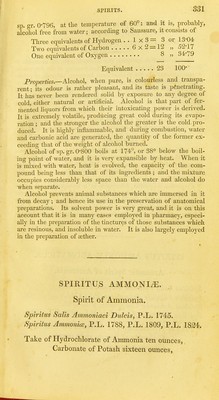
![sp. gr. 0-796, at the temperature of 60°: and it is, probably, alcohol free from water; according to Saussure, it consists of Three equivalents of Hydrogen . . 1 x 3= 3 or 13-04. Two equivalents of Carbon 6 x 2 = 12 „ 52-17 One equivalent of Oxygen 8 „ 34-79 Equivalent 23 100- Properiies.—Alcoho], when pure, is colourless and transpa- rent ; its odour is rather pleasant, and its taste is penetrating. It has never been rendered solid by exposure to any degree of cold, either natural or artificial. Alcohol is that part of fer- mented liquors from which their intoxicating power is derived. It is extremely volatile, producing great cold during its evapo- ration ; and the stronger the alcohol the greater is the cold, pro- duced. It is highly inflammable, and during combustion, water and carbonic acid are generated, the quantity of the former ex- ceeding that of the weight of alcohol burned. Alcohol of sp. gr. 0-800 boils at 174°, or 38° below the boil- ing point of water, and it is very expansible by heat. When it is mixed with water, heat is evolved, the capacity of the com- pound being less than, that of its ingredients ; and the mixture occupies considerably less space than the water and alcohol do when separate. Alcohol prevents animal substances which are immersed in it from decay; and hence its use in the preservation of anatomical preparations. Its solvent power is very great, and it is on tliis account that it is in many cases employed in pharmacy, especi- ally in the preparation of the tinctures of those substances Avhich are resinous, and insoluble in water. It is also largely employed in the preparation of aether. SPIRITUS AMMONITE. Spirit of Ammonia. Spiritiis Salts Ammoniaci Dulcis, P.L. 1745. Spiritus AmmonicB, P.L. 1788, P.L. 1809, P.L. 1824-. Take of Hydrochlorate of Ammonia ten ounces, Carbonate of Potash sixteen ounces,](https://iiif.wellcomecollection.org/image/b21297204_0355.jp2/full/800%2C/0/default.jpg)