Kirkes' handbook of physiology. / By W. Morrant Baker and Vincent Dormer Harris.
- William Senhouse Kirkes
- Date:
- 1888
Licence: Public Domain Mark
Credit: Kirkes' handbook of physiology. / By W. Morrant Baker and Vincent Dormer Harris. Source: Wellcome Collection.
Provider: This material has been provided by Royal College of Physicians, London. The original may be consulted at Royal College of Physicians, London.
105/912 page 81
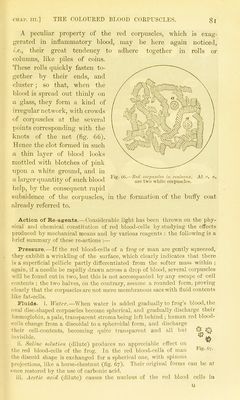
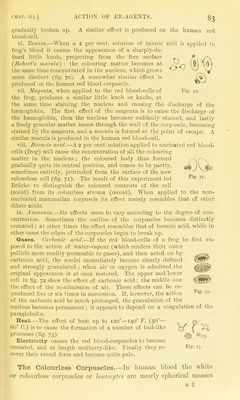
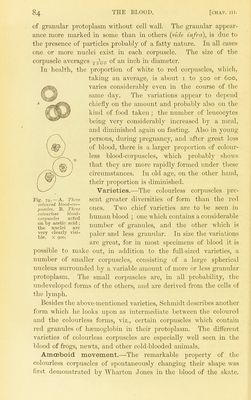
![A peculiar property of tlie red corpuscles, -which is exag- gerated in inflammatory blood, may be here again noticed, i.e., their great tendency to adhere together in rolls or columns, like piles of coins. These rolls quickly fasten to- gether by their ends, and cluster; so that, when the blood is spread out thinly on n glass, they form a kind of irregular network, with crowds of corpuscles at the several points con-esponding with the knots of the net (fig. 66). Hence the clot formed in such u thin layer of blood looks mottled with blotches of pink Tipon a white ground, and in a larger quantity of such blood help, by the consequent rapid subsidence of the corpuscles, already referred to. Fig. 66.- -lied corpuscles in rouleaux. At are two wliite corpuscles. in the formation of the bufFy coat Action of Ke-agreuts.—Considerable light has been thrown on the phy- sical and chemical constitution of red blood-cells by studying the eifects produced by mechanical means and by various reagents : the following is a brief summary of these re-actions :— Pressure.—If the red blood-cells of a frog or man are gently squeezed, Ihey exhibit a wj inkling of the surface, which clearly indicates that there is a superficial pellicle partly differentiated from the softer mass within ; ngain, if a needle be rapidly drawn across a drop of blood, several corpuscles will be found cut in two, but this is not accompanied by any escape of cell <'ontents ; the two halves, on the contrary, assume a rounded form, proving clearly that the corpuscles are not mere membranous sacs with fluid contents like fat-cells. Fluids, i. Water.—When water is added gradually to frog's blood, the oval disc-shaped corpuscles become splierical, and gradually discharge their liicmoglobin, a pale, transparent stroma being left behind ; human red blood- <!q11s change from a di.scoidal to a spheroidal form, and discharge their cell-contents, becoming (juite transparent and all but iiivisiVjle. ii. Saline nolutiini (dilute) produces no appreciable effect on the red blood-cells of the frog. In the red blood-cells of man the discoid shape is exchanged for a sphcri(!al one, with spinous ])rojections, like a horse-chestnut (fig. 67). Their original forms can be at once restored by the use of carbonic acid. iii. Acetic acid (dilute) causes the inicleus of tlic red blood cells in Figr. 67.](https://iiif.wellcomecollection.org/image/b24757226_0105.jp2/full/800%2C/0/default.jpg)
 No text description is available for this image
 No text description is available for this image
 No text description is available for this image