Some problems of medical education in London : an address / by W.H. Allchin.
- Allchin, William Henry, Sir, 1846-1911.
- Date:
- 1907
Licence: In copyright
Credit: Some problems of medical education in London : an address / by W.H. Allchin. Source: Wellcome Collection.
Provider: This material has been provided by The Royal College of Surgeons of England. The original may be consulted at The Royal College of Surgeons of England.
3/26
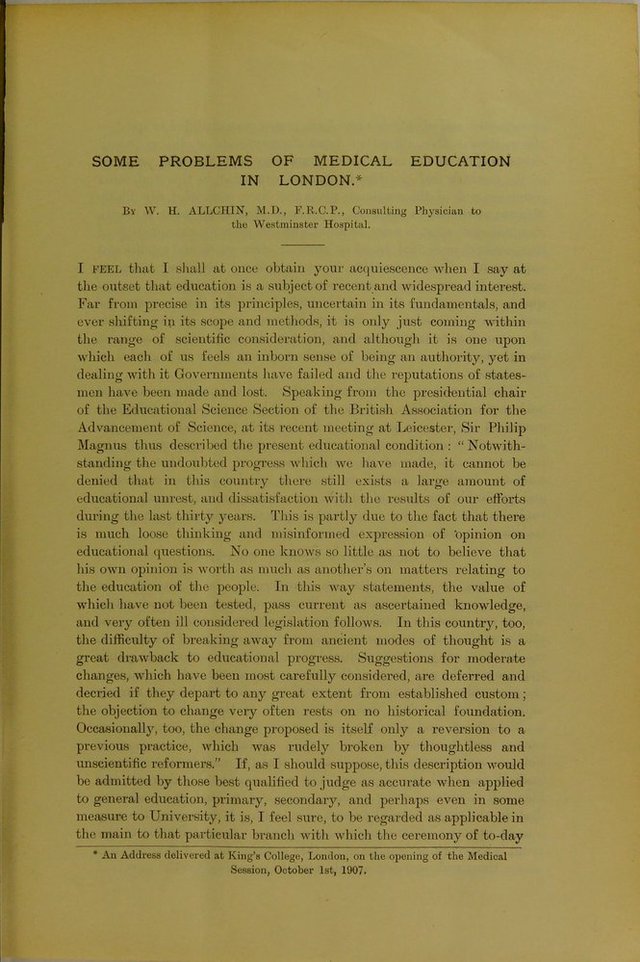
![SOME PROBLEMS OF MEDICAL EDUCATION IN LONDON.* Bv W. H. ALLCHIN, M.U., F.R.C.P., Consulting Physician to the Westminster Hospital. I FEEL that I sliall at once obtain your ac(]uiescence wlien I say at tlie outset that education is a subject of recent and widespread interest. Far from precise in its principles, uncertain in its fundamentals, and ever shifting in its scope and methods, it is only ju.st coming within the range of scientific consideration, and although it is one upon which each of us feels an inborn sense of being an authority, yet in dealing with it Governments have failed and the reputations of states- men have been made and lost. Speaking from the presidential chair of the Educational Science Section of the British Association for the Advancement of Science, at its recent meeting at Leicester, Sir Philip Magnus thus described the present educational condition : “ Notwith- standing the undoubted progress which we have made, it cannot be denied that in this country there still exists a large amount of educational unrest, and dissatisfaction with the results of our efforts during the last thirty years. This is partly due to the fact that there is much loose thinking and misinformed expression of ‘opinion on educational questions. No one knows so little as not to believe that his own opinion is worth as much as another’s on matters relating to the education of the people. In this way statements, the value of which have not been tested, pass current as ascertained knowledge, and very often ill considered legislation follows. In this country, too, the difficulty of breaking away from ancient modes of thought is a great drawback to educational progTess. Suggestions for moderate changes, which have been most carefully considered, are deferred and decried if they depart to any great extent from established custom; the objection to change very often rests on no historical foundation. Occasionally^ too, the change proposed is itself only a reversion to a previous practice, which was rudely broken by thoughtless and unscientific reformers.” If, as I should suppose, this description would be admitted by those best qualified to judge as accurate when applied to general education, primary, secondary, and perhaps even in some measure to University, it is, I feel sure, to be regarded as applicable in the main to that particular branch with which the ceremony of to-day * An Address delivered at King’s College, London, on the opening of the Medical Session, October 1st, 1907.](https://iiif.wellcomecollection.org/image/b22406980_0005.jp2/full/800%2C/0/default.jpg)