Volume 1
A text-book of medicine for students and practitioners / by Adolf v. Strümpell.
- Adolph Strümpell
- Date:
- 1911
Licence: Public Domain Mark
Credit: A text-book of medicine for students and practitioners / by Adolf v. Strümpell. Source: Wellcome Collection.
832/874 page 798
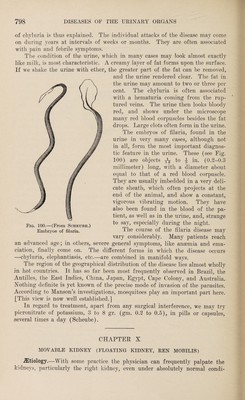
![of chyluria is thus explained. The individual attacks of the disease may come on during years at intervals of weeks or months. They are often associated with pain and febrile symptoms. The condition of the urine, which in many cases may look almost exactly like milk, is most characteristic. A creamy layer of fat forms upon the surface. If we shake the urine with ether, the greater part of the fat can be removed, and the urine rendered clear. The fat in the urine may amount to two or three per cent. The chyluria is often associated with a hematuria coming from the rup¬ tured veins. The urine then looks bloody red, and shows under the microscope many red blood corpuscles besides the fat drops. Large clots often form in the urine. The embryos of filaria, found in the urine in very many cases, although not in all, form the most important diagnos¬ tic feature in the urine. These (see Fig. 100) are objects to in. (0.2-0.3 millimeter) long, with a diameter about equal to that of a red blood corpuscle. They are usually imbedded in a very deli¬ cate sheath, which often projects at the end of the animal, and show a constant, vigorous vibrating motion. They have also been found in the blood of the pa¬ tient, as well as in the urine, and, strange to say, especially during the night. The course of the filaria disease may vary considerably. Many patients reach an advanced age; in others, severe general symptoms, like anaemia and ema¬ ciation, finally come on. The different forms in which the disease occurs —clryluria, elephantiasis, etc.—are combined in manifold ways. The region of the geographical distribution of the disease lies almost wholly in hot countries. It has so far been most frequently observed in Brazil, the Antilles, the East Indies, China, Japan, Egypt, Cape Colony, and Australia. Nothing definite is yet known of the precise mode of invasion of the parasites. According to Manson’s investigations, mosquitoes play an important part here. [This view is now well established.] In regard to treatment, apart from any surgical interference, we may try picronitrate of potassium, 3 to 8 gr. (gm. 0.2 to 0.5), in pills or capsules, .several times a day (Seheube). Fig. 100.—(From Scheube.) Embryos of filaria. CHAPTER X MOVABLE KIDNEY (FLOATING KIDNEY, REN MOBILIS) etiology.—With some practice the physician can frequently palpate the kidneys, particularly the right kidney, even under absolutely normal condi-](https://iiif.wellcomecollection.org/image/b3136276x_0001_0832.jp2/full/800%2C/0/default.jpg)