Report of the Director-General of Public Health, New South Wales.
- New South Wales. Department of Public Health
- Date:
- [1937]
Licence: Public Domain Mark
Credit: Report of the Director-General of Public Health, New South Wales. Source: Wellcome Collection.
52/154 page 40
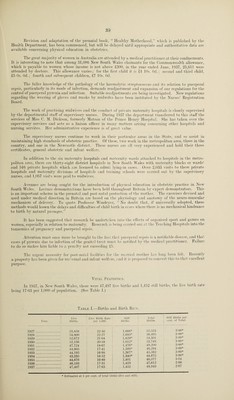
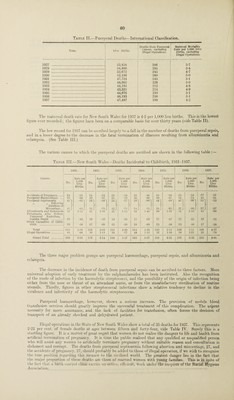
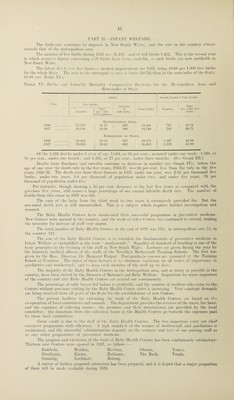
![Table IT.—Puerperal Deaths—International Classification. Year. Live Birtlis. Deaths from Puerperal Causes, excluding Illegal Operations. Maternal Mortality Bate per 1,000 Live Births, excluding Illegal Operations. 1927 . 53,858 54,800 52,672 52,136 47,724 44,905 44,195 43,335 44,676 46,193 47,497 306 5-7 1928 . 295 5-4 1929 . 245 4-7 1930 . 260 5-0 1931 . 243 51 1932 . 226 50 1933 . 212 4-8 1934 . 214 4-9 1935 . 230 51 1936 . 236 5-1 1937 . 198 4-2 The maternal death rate for New South Wales for 1937 is 4-2 per 1,000 live births. This is the lowest figure ever recorded; tho figures have been on a comparable basis for over thirty years (vide Table II). The low record for 1937 can be ascribed largely to a fall in the number of deaths from puerperal sepsis, and in a lesser degree to the decrease in the fatal termination of illnesses resulting from albuminuria and eclampsia. (See Table III.) Tho various causes to which the puerperal deaths are ascribed are shown in the following table :— Table III.—New South Wales—Deaths Incidental to Childbirth, 1931-1937. Causes. 1931. 1932. 1933. 1934. 1935. 1936. , 1937. No. Kate per 1,000 Live Births. No. Rate per 1,000 Live Births. No. Bate per 1,000 live Births. No. Bate per 1,000 Live Births. No. Bate per 1,000 Live Births. No. Kate per 1,000 Live Births. No. Bate per 1,000 Live Births. Accidents of Pregnancy. 24 ■53 24 •53 26 •59 20 •46 13 •29 25 •54 27 •57 Puerperal Haemorrhage ... 33 •09 39 •87 31 •70 30 •69 39 •87 34 •74 43 •91 Puerperal Septicaemia 411 -ss q 261 •58 I 341 •77] 391 •901 441 •991 451 •981 251 •52 „ ,, following 1 l l i l [ l l L L L l l Abortion or r f f r f r r r r r r r r Miscarriage... 41 J •85 J 33 J •73 J 32 J •73 J 24 J •55 J 28 J •63 J 37 | •80 J 27 J •57 Albuminuria and Eclampsia 93 HI 01 1-36 51 115 64 1-48 60 1-34 51 1-10 43 •90 Phlegmasia Alba Dolens, Puerperal Embolism, Sudden Death . 23 •48 16 •30 16 •36 11 •26 21 •47 21 •45 16 •34 Other Casualties of Child- birth . 28 •58 27 •60 22 •50 26 •60 25 •56 23 •50 17 •36 Total . 243 5'09 226 5-03 212 4-80 214 4-94 230 5-15 236 5-11 198 4-17 Illegal Operations . 45 •94 50 1-11 34 •77 49 113 52 1-16 56 1-21 35 •74 Grand Total . 288 6'03 276 614 246 5-57 263 607 282 6-31 292 6-32 233 4-91 The three major problem groups are puerperal haemorrhage, puerperal sepsis, and albuminuria and eclampsia. The decrease in the incidence of death from puerperal sepsis can be ascribed to three factors. More universal adoption of early treatment by the sulphanilamides has been instituted. Also the recognition of the mode of infection by the haemolytic streptococci, and the possibility of the origin of infection being either from the nose or throat of an attendant nurse, or from the unsatisfactory sterilisation of routine utensils. Thirdly, figures in other streptococcal infections show a relative tendency to decline in the virulence and infectivity of the haemolytic streptococcus. Puerperal haemorrhage, however, shows a serious increase. The provision of mobile blood transfusion services should greatly improve the successful treatment of this complication. The urgent necessity for more assistance, and the lack of facilities for transfusion, often forces the decision of transport of an already shocked and dehydrated patient. Illegal operations in the State of New South Wales show a total of 35 deaths for 1937. This represents 2-22 per cent, of female deaths at ages between fifteen and forty-four, vide Table IV. Surely this is a startling figure. It is a matter of great regret that women do not realise the dangers to life and health from artificial termination of pregnancy. It is time the public realised that any qualified or unqualified person who wall assist any women to artificially terminate pregnancy without suitable reason and consultation is dishonest and corrupt. The deaths from puerperal septicaemia following abortion and miscarriage, 27, and the accidents of pregnancy, 27, should probably be added to those of illegal operation, if we wish to recognise the true position regarding this menace to the civilised world. The greatest danger lies in the fact that t he major proportion of these deaths are those of married women with young families. This is in spite of the fact that a birth control clinic carries on active, efficient, work under tho auspices of the Racial Hygiene Association.](https://iiif.wellcomecollection.org/image/b31485285_0052.jp2/full/800%2C/0/default.jpg)