Ocular therapeutics / by L. de Wecker ; translated and edited by Litton Forbes.
- Date:
- 1879
Licence: Public Domain Mark
Credit: Ocular therapeutics / by L. de Wecker ; translated and edited by Litton Forbes. Source: Wellcome Collection.
Provider: This material has been provided by the Royal College of Physicians of Edinburgh. The original may be consulted at the Royal College of Physicians of Edinburgh.
561/576 page 541
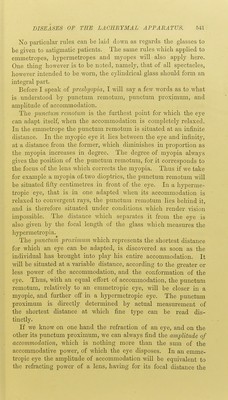
![No particular rules can be laid down as regards the glasses to be given to astigmatic patients. The same rules which applied to emmetropes, hypermetropes and myopes will also apply here. One thing however is to be noted, namely, that of all spectacles, however intended to be worn, the cylindrical glass should form an integral part. Before I speak of preshyoina, T will say a few words as to what is understood by punctum remotum, punctum proximum, and amplitude of accommodation. The lyiinctum remotum is the furthest point for which the eye can adapt itself, when the accommodation is completely relaxed. In the emmetrope the punctum remotum is situated at an infinite distance. In the myopic eye it lies between the eye and infinit}--, at a distance from the former, which diminishes in proportion as the myopia increases in degree. The degree of myopia always gives the position of the punctum remotum, for it corresponds to the focus of the lens which corrects the myopia. Thus if we take for example a myopia of two dioptrics, the punctum remotum will be situated fifty centimetres in front of the eye. In a hyperme- tropic eye, that is in one adapted when its accommodation is relaxed to convergent rays, the punctum remotum lies behind it, and is therefore situated under conditions which render vision impossible. The distance which separates it from the eye is also given by the focal length of the glass which measures the hypermetropia. The ]pimctum iiroximum which represents the shortest distance for which an eye can be adapted, is discovered as soon as the individual has brought into play his entire accommodation. It will be situated at a variable distance, according to the greater or less power of the accommodation, and the conformation of the eye. Thus, with an equal effort of accommodation, the punctum remotum, relatively to an emmetropic eye, will be closer in a myopic, and further off in a hypermetropic eye. The punctum proximum is directly determined by actual measurement of the shortest distance at which fine type can be read dis- tinctly. If we know on one hand the refraction of an eye, and on the other its punctum proximum, we can always find the amplitude of accommodation, which is nothing more than the sum of the accommodative power, of which the eye disposes. In an emme- tropic eye the amplitude of accommodation will be equivalent to the refracting power of a lens, having for its focal distance the](https://iiif.wellcomecollection.org/image/b21948823_0561.jp2/full/800%2C/0/default.jpg)