Report on gun-shot and sabre wounds of invalids sent to Fort Pitt during the years 1860-61 / by Thomas Longmore.
- Longmore, Sir Thomas, 1816-1895.
- Date:
- [1863]
Licence: Public Domain Mark
Credit: Report on gun-shot and sabre wounds of invalids sent to Fort Pitt during the years 1860-61 / by Thomas Longmore. Source: Wellcome Collection.
Provider: This material has been provided by The Royal College of Surgeons of England. The original may be consulted at The Royal College of Surgeons of England.
14/38 page 10
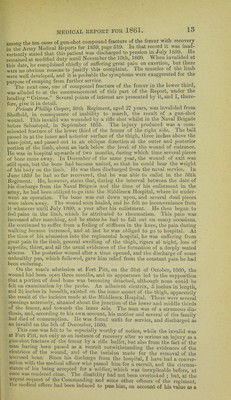
![lesions described, there resulted pai-tial inability to flex the fore arm upon the upper ann, and also loss of deltoid power ot'elevating the h.une J '£ latter was in some degree compensated by increased development of tlie upper poi tion of the trapezius muscle on the same side. This soldier was sent to the depot of his regiment and recommended for modified duty ; but not retained Ue was ultimately discharged from the army in October, 18G0 In each of the two remaining cases of this Order, a musket-ball had passed through the interosseous space of the fore arm. The injury had led to con- tractiou of the elbow-joint and wasting of the brachial muscles in one instance, and to contraction of tlie middle and ring fingers in the second. Both soldiers bad to be discharged from the service in consequence of these contractions. llie sixth was a simple flesh wound in the upper arm and calls for no remark. The situation of the compound fractures (which were all instances, with one exception, of complete fracture) in the seventeen cases of Order 4, of this class, is shown in the following table:— Humerus.. .. .. .. .. .. 9 Humerus and Scapida .. .. .. .. 1 Kudius .. .. ., .. .. .. 1 Ulna, .. .. .. .. ., .. 3 Scapida .. .. ., .. ., .. 1 Clavicle .. .. .. ., .. .. 1 Clavicle and Scapula .. .. .. .. 1 Total 17 All these injuries were caused by musket balls, with the exception of one which was caused by a fragment of sliell. Tliis was the case in which there was only partial fracture. Tlie piece of shell entered and lodged near the insertion of the deltoid muscle ; at tlie same time breaking off several splinters of tlie bone, which were removed. An adherent cicatrix resulted, and pain was caused on elevating or rotating the arm. There was no wasting of the muscles, and the pain complained of appeared to be exaggerated. This patient was dismissed to modified duty ; but sent back, and eventually discharged fi-om the service. The usual causes of invaliding in these injuries were loss of power in the extremity—resulting firstly, from injury to nerves, inducing loss of sensation, atrophy, and contractions ; or secondly, from binding down of muscles and other tissues by firm adhesions in consequence of tlie inflanimation attendant upon tlie original wounds, or from cicatricial adhesions to bone after the removal of necrosed sequestra ; or, thirdly, from ancliylosis of joints, wiien the fractures occurred near the articular extremities of liones. In one instance only—in one in which the fracture occurred in the clavicle—was the discharge of the patient from the service due to non-union of the fractured bone. One case afforded an example of fracture, and at the same time splitting of the ball and injury in a double direction. Sergeant S. St. John, a healthy young soldier of the 28th Regiment, was wounded at the storming of the Fort of Beyt, on the 6th of October, 1859, by a musket-ball, whicli struck him on the ulna of the right arm, about four inclies below the olecranon. He was loading his musket at the time he was hit, so that the bent position of the arm explained the injuries which followed. The ball fractured the ulna, and was itself also split into two parts; one section of the ball passed out close to the external condyle of the liumerus, ajjparently injuring the capsule of the joint in its passage ; the other section, running up through tbe soft parts, passed out about five inches above the elbow. Great inflammation, both of the joint and of the upper arm, followed. Amputation was several tiroes contemplated, in consequence of the profuse suppuration and im])airmcnt to genend health with which it was accompanied ; but eventually the sergeant recovered with anchylosis of the joint and some wasting of muscles. He retained fair power of moving the lingers. One case, in which the liuincrus was fractured three inches and a half below the acromion process of the scapula, near the insertion of the deltoid muscle, was accoiii()niiieil with contusion of the chest and also of the lung, evidenced by hccmoptysis at the time of the injury. The baU, after fracturing the humerus,](https://iiif.wellcomecollection.org/image/b22292226_0014.jp2/full/800%2C/0/default.jpg)
 No text description is available for this image
 No text description is available for this image
 No text description is available for this image