Spasm in chronic nerve disease : being the Gulstonian lectures delivered at the Royal College of Physicians of London, March 1886.
- Sharkey, Seymour J.
- Date:
- 1886
Licence: Public Domain Mark
Credit: Spasm in chronic nerve disease : being the Gulstonian lectures delivered at the Royal College of Physicians of London, March 1886. Source: Wellcome Collection.
Provider: This material has been provided by the Augustus C. Long Health Sciences Library at Columbia University and Columbia University Libraries/Information Services, through the Medical Heritage Library. The original may be consulted at the the Augustus C. Long Health Sciences Library at Columbia University and Columbia University.
31/130 page 21
![later in the history of the case. This is probably due to sclerosis appearing in the opposite lateral column, as Pitres has shows that it often does ; and Mr. Sherrington has shown that it occurs in dogs which have had one pyramidal tract experimentally injured. But, although this is pro- bably the cause of most cases of bilateral spasm from uni- lateral lesion, the possibility of the presence of a bilateral lesion must be borne in mind. In the ' Eevue de Medecine ' for May, 1883, Emile Demange records a case of the kind where a bilateral lesion was found in the brain post mortem. Leaving affections of the cortical and subcortical portions of the pyramidal tract, let us pass to a consideration of the symptoms which accompany diseases of it as it traverses the basal ganglia, crura cerebri, pons Varolii, and medulla oblongata. It is needless, before an audience like the present, to recount cases of hemiplegia followed by rigidity, which result from destruction of the internal capsule by haemor- rhage or softening. Such examples of disease are of common occurrence and well known to all. I shall rather give an account of a series of cases which are less fre- quently met with, and which made a considerable impres- sion upon me from two points of view: 1. Because they seem to throw light on the rigidity and tetanic seizures which are observed in tumours of the cerebellum. 2. Because I failed to recognise the position of the disease in the brain during life, though a reconsideration of the symptoms leads me to think that others might have succeeded. Case in which a Tubercular Mass occu]3ied both Optic Thalami, producing Paralysis, Tremors, and Rigidity of the Limbs.—F. P—, aet. 4, v^^as admitted into St. Thomas's Hospital under Mr. Sydney Jones, in August, 1878, and on the 22nd of the following October excision of the left astragalus was performed. The child did very well, and was bright and playful until January 28th, 1879, when](https://iiif.wellcomecollection.org/image/b21207379_0031.jp2/full/800%2C/0/default.jpg)
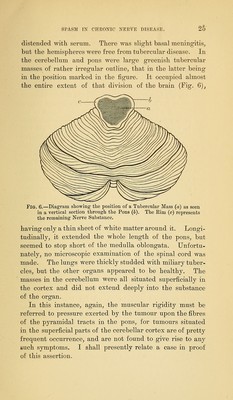
 No text description is available for this image
 No text description is available for this image
 No text description is available for this image