Louise Lateau of Bois d'Haine : her life, her ecstasies, and her stigmata, a medical study / by F. Lefebvre ; translated from the French ; edited by J. Spencer Northcote.
- Lefebvre, Ferdinand J. M., 1821-1902.
- Date:
- 1873
Licence: Public Domain Mark
Credit: Louise Lateau of Bois d'Haine : her life, her ecstasies, and her stigmata, a medical study / by F. Lefebvre ; translated from the French ; edited by J. Spencer Northcote. Source: Wellcome Collection.
Provider: This material has been provided by the Francis A. Countway Library of Medicine, through the Medical Heritage Library. The original may be consulted at the Francis A. Countway Library of Medicine, Harvard Medical School.
220/240 (page 208)
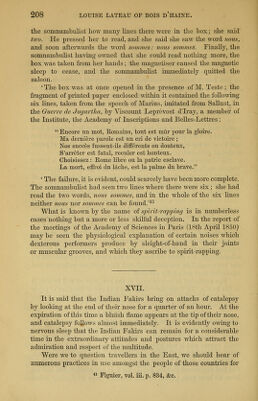
![tlie somnambiilist how man}'- lines there were in the box; she said tivo. He pressed her to read, and she said she saw the word )ious, and soon afterwards the word sommes: nous soimnes. Finally, the somnambuhst having owned that she could read notliing more, the box was taken from her hands; the magnetiser caused the magnetic sleej) to cease, and the somnambuhst immediately quitted the saloon. ' The box was at once opened in the x^i'esence of M. Teste; the fragment of printed pa^^er enclosed witliin it contained the following six lines, taken from the speech of Maiius, imitated from Sallust, in the Guerre de Jugurtha, by Viscount Leprevost d'lraj, a member of the Institute, the Academy of Inscriptions and BeUes-Lettres : Encore un mot, Remains, tout est mur pour la glou'e. Ma derniere parole est un cri de victoire ; Nos succes fussent-ils differents ou douteus, S'arreter est fatal, reculer est honteux. Choisissez : Rome libre ou la patrie esclave. La mort, effroi du lache, est la palme du brave. ' The failure, it is evident, could scarcely have been more complete. The somnambuhst had seen two hues where there were six; she had read the two words, nous sommes, and in the whole of the six hues neither jious nor sommes can be found.'^^ What is known by the name of spirit-rcqyping is in numberless cases nothing but a more or less skilful deception. In the report of the meetings of the Academj^ of Sciences in Paris (18th AjDril 1850) may be seen the physiological explanation of certain noises wliich dexterous jDcrformers produce by sleight-of-hand in their joints or muscular grooves, and which they ascribe to spirit-rapx3ing. XVII. It is said that the Indian Fakirs bring on attacks of catalepsy by looking at the end of their nose for a quarter of an hour. At the expiration of this time a bluish flame appears at the ti]5 of their nose, and catalepsy follows almost immediately. It is e^ddently owing to nervous sleej) that the Indian Fakirs can remain for a considerable time in the extraordinary attitudes and ];)Ostures which attract the admiration and respect of the multitude. Were we to question travellers in the East, we should hear of numerous practices in use amongst the people of those countries for « Figuier, vol. iii. p. 834, &c.](https://iiif.wellcomecollection.org/image/b21063904_0220.jp2/full/800%2C/0/default.jpg)