The susceptible region in A-V conduction / by Thomas Lewis, Paul D. White and John Meakins.
- Thomas Lewis
- Date:
- [1914?]
Licence: Public Domain Mark
Credit: The susceptible region in A-V conduction / by Thomas Lewis, Paul D. White and John Meakins. Source: Wellcome Collection.
3/14
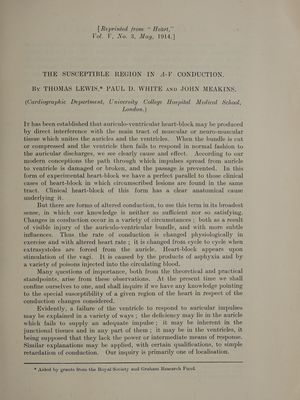
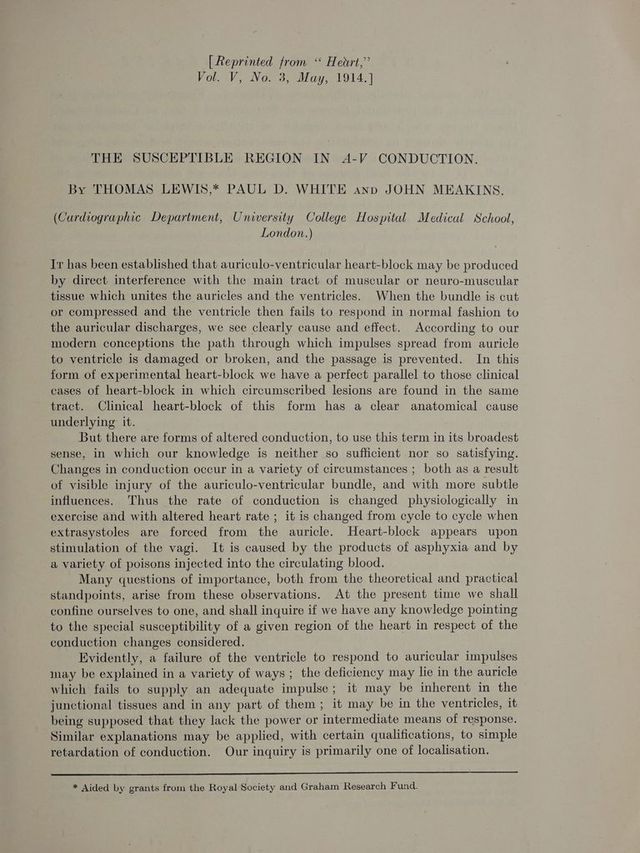
![[Reprinted from ‘ Hett,’ Vol. V, No. 3, May, 1914.] THE SUSCEPTIBLE REGION IN A-V CONDUCTION. By THOMAS LEWIS,* PAUL D. WHITE ann JOHN MEAKINS, (Cardiographic. Department, University College Hospital Medical School, London.) Ir has been established that auriculo-ventricular heart-block may be produced by direct interference with the main tract of muscular or neuro-muscular tissue which unites the auricles and the ventricles. When the bundle is cut or compressed and the ventricle then fails to respond in normal fashion to the auricular discharges, we see clearly cause and effect. According to our modern conceptions the path through which impulses spread from auricle to ventricle is damaged or broken, and the passage is prevented. In this form of experimental heart-block we have a perfect parallel to those clinical cases of heart-block in which circumscribed lesions are found in the same tract. Clinical heart-block of this form has a clear anatomical cause underlying it. | But there are forms of altered conduction, to use this term in its broadest sense, in which our knowledge is neither so sufficient nor so satisfying. Changes in conduction occur in a variety of circumstances ; both as a result of visible injury of the auriculo-ventricular bundle, and with more subtle influences. Thus the rate of conduction is changed physiologically in exercise and with altered heart rate ; it is changed from cycle to cycle when extrasystoles are forced from the auricle. Heart-block appears upon stimulation of the vagi. It is caused by the products of asphyxia and by a variety of poisons injected into the circulating blood. Many questions of importance, both from the theoretical and practical standpoints, arise from these observations. At the present time we shall confine ourselves to one, and shall inquire if we have any knowledge pointing to the special susceptibility of a given region of the heart in respect of the conduction changes considered. Evidently, a failure of the ventricle to respond to auricular impulses may be explained in a variety of ways ; the deficiency may lie in the auricle which fails to supply an adequate impulse; it may be inherent in the junctional tissues and in any part of them; it may be in the ventricles, it being supposed that they lack the power or intermediate means of response. Similar explanations may be applied, with certain qualifications, to simple retardation of conduction. Our inquiry is primarily one of localisation. ce Ea aaa ae ae eee Ae Se ee * Aided by grants from the Royal Society and Graham Research Fund.](https://iiif.wellcomecollection.org/image/b33430433_0003.jp2/full/800%2C/0/default.jpg)