Orthopedic surgery / by Edward H. Bradford and Robert W. Lovett.
- Bradford, Edward H.
- Date:
- 1912
Licence: In copyright
Credit: Orthopedic surgery / by Edward H. Bradford and Robert W. Lovett. Source: Wellcome Collection.
Provider: This material has been provided by UCL Library Services. The original may be consulted at UCL (University College London)
32/426 (page 20)
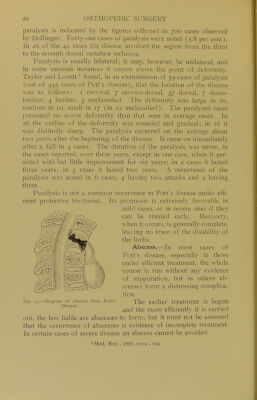
![paralysis is indicated by the figures collected in 700 cases observed by Dollinger. Forty-one cases of paralysis were noted ( 5.8 per cent). In _>() of the 41 cases the disease involved the region from the third to the seventh dorsal vertebra? inclusive. Paralysis is usually bilateral; it may, however, be unilateral, and in some unusual instances it occurs above the point of deformity. Taylor and Lovett1 found, in an examination of 59 cases of paralysis (out of 445 cases of Pott's disease), that the location of the disease was as follows: 1 cervical, 7 cervico-dorsal, 37 dorsal, 7 dorso- lumbar, 4 lumbar, 3 unclassified. The deformity was large in 20, medium in to, small in 17 (in 12 unclassified). The paralyzed cases presented no worse deformity than that seen in average cases. In 26 the outline of the deformity was rounded and gradual; in 16 it was distinctly sharp. The paralysis occurred on the average about two years after the beginning of the disease. It came on immediately after a fall in 4 cases. The duration of the paralysis was never, in the cases reported, over three years, except in one case, when it per- sisted with but little improvement for six years; in 2 cases it lasted three years; in 5 cases it lasted two years. A recurrence of the paralysis was noted in 6 cases, 4 having two attacks and 2 having three. Paralysis is not a common occurrence in Pott's disease under effi- cient protective treatment. Its prognosis is extremely favorable in mild cases, or in severe ones if they can be treated early. Recovery, when it occurs, is generally complete, leaving no trace of the disability of the limbs. Abscess.—In most cases of Pott's disease, especially in those under efficient treatment, the whole course is run without any evidence of suppuration, but in others ab- scesses form a distressing complica- tion. Fig. 17.—Diagram of Abscess from Pott's The earlier treatment is begUIl ] ' I 5' 1 5' • and the more efficiently it is carried out, the less liable are abscesses to form; but it must not be assumed that the occurrence of abscesses is evidence of incomplete treatment. In certain cases of severe disease an abscess cannot be avoided. ^ed. Rec , 18S6, xxix , 699](https://iiif.wellcomecollection.org/image/b21291093_0032.jp2/full/800%2C/0/default.jpg)