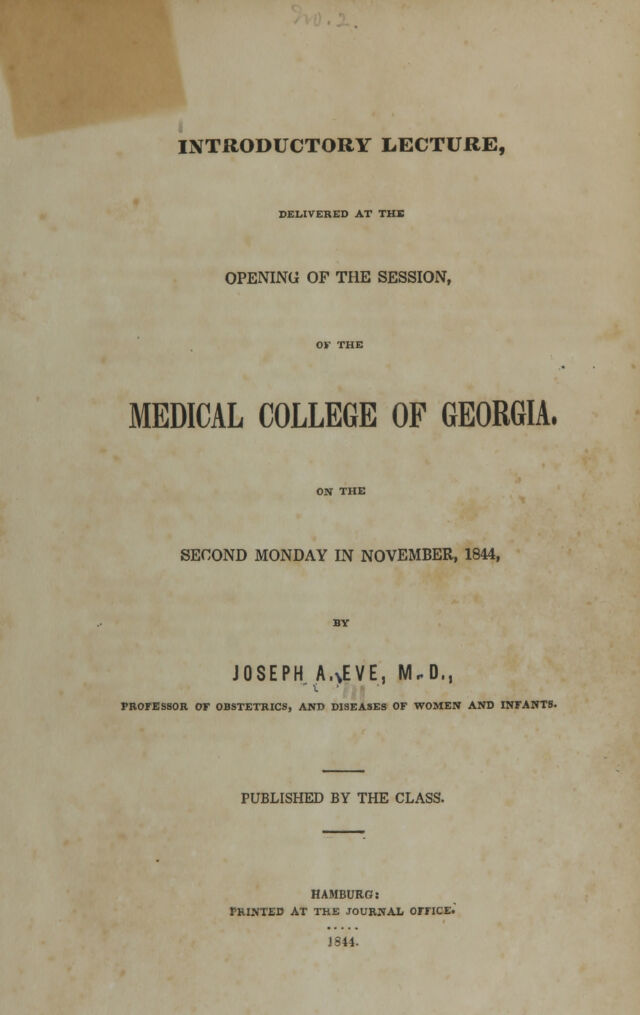
Introductory lecture, delivered at the opening of the session of the Medical College of Georgia : on the second Monday in November, 1844 / by Joseph A. Eve.
- Eve, Joseph A. (Joseph Adams), 1805-1886
- Date:
- 1844
Licence: Public Domain Mark
Credit: Introductory lecture, delivered at the opening of the session of the Medical College of Georgia : on the second Monday in November, 1844 / by Joseph A. Eve. Source: Wellcome Collection.
Provider: This material has been provided by the National Library of Medicine (U.S.), through the Medical Heritage Library. The original may be consulted at the National Library of Medicine (U.S.)
9/22
![[9] This indeed is a painful office, from the performance of which the physician, if his nature be a kindly one, will involuntarily shrink ; but however severe the duty, he must yet perform it, as he must an- swer at that awful tribunal, before which, both physician and patient must soon appear. In that dread account which he must there render, it can be no light matter, that when an immortal being was trembling on the verge of eternity, he deceived him with flattering lips, till death, com- ing upon him like a thief, cut off his opportunities of preparation and hurried him into the presence of his God ! Our profession is heie apt to be in fault: we are too much accustom- ed to regard the material part of man as alone worthy of our care, for- getting that he has a spiritual part which is immortal, or considering the interests of the latter entrusted entirely to another profession. The reason of this is not as was formerly supposed, because the profession of medicine disposes to infidelity— this charge has not only been long disp'oven, but :he reverse of it satisfactorily established. The medical profession, in point of fact, has for many years been re- markable for the high tone of morality and the elevated standard of religious character among its members. This dereliction of duty arises from an aversion to impart painful in- telligence, and an apprehension of its injurious influence upon tho patient. It is the physician's duty to keep steadily in view the spiritual as well as temporal good of his patient, and promote it in every way, within his power. But should he not have tine or disposition himself, to render the services of religion to his patients, he ought certainly not to prevent others who have. When a sick man desires religious counsel or spiritual comfort, the physician's interdiction is a violation of the most sacred rights of suffering humanity—oppression more tyrannic than the Des- pot's chain—usurpation most unwarrantable and unholy—it is 1o rob the soul and defraud Heaven. Judgment and care are indeed requisite in such cases, but unnecessary apprehension is generally entertained, both by friends and physicians, as to religious intercourse with the sick. The glorious hopes, the cheering consolation?, the bright promises, held](https://iiif.wellcomecollection.org/image/b2111836x_0009.jp2/full/800%2C/0/default.jpg)


 No text description is available for this image
 No text description is available for this image
 No text description is available for this image