An elementary text-book of botany / translated from the German of K. Prantl ... ; the translation revised by S.H. Vines.
- Prantl, Karl Anton Eugen, 1849-1893.
- Date:
- 1881
Licence: Public Domain Mark
Credit: An elementary text-book of botany / translated from the German of K. Prantl ... ; the translation revised by S.H. Vines. Source: Wellcome Collection.
Provider: This material has been provided by University of Bristol Library. The original may be consulted at University of Bristol Library.
27/360 page 15
![§4.] 1. Foliage leaves, usuallj known simply as leaves (Fig. 13 If). This is the most general form. These leaves are conspicuous on account of their green colour, and in accordance with their function (see § 33), they are exposed as much as possible to the sun-light. If they are small they are very numerous (Conifers), and the larger they are the fewer they are (Sun - flower, Paul- ownia). They always possess a well-developed lamina, which presents the various peculiarities of form previously described. 2. Scales or cataphyllary leaves (¥ig. 13 N). These are usually of a yellow or brown colour, of simple structure, without project- ing veins, and attached to the stem by a broad base. They may be regarded as the sheaths of leaves, the petioles and laminae of which have not been developed; this is true even in the case of those plants the foliage-leaves of which usually develope no sheaths. They always oc- cur on subterranean stems (e.g., the scales of the Onion), and sometimes on aerial stems. Many plants which are not green (Oro- banche, Neottia) produce only cataphyllary leaves in addition to the floral organs. The most common form in which they occur upon aerial stems is that of scales investing the buds of trees. In this case they are the lowest leaf-structures borne by the annual shoot, and usually fall off as the bud developes. Some indigenous trees have naked buds without scales, as Viburnum Lantana Fig. 13.—The three forms of leaves on the stem of MaiaiitJiemum bi/olmm (nat. size) ; jV the scales; 1 the foliage leaves; H d the bracts; I) the flowers in their axils: V3 roots.](https://iiif.wellcomecollection.org/image/b21446052_0027.jp2/full/800%2C/0/default.jpg)
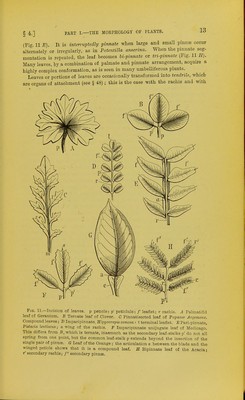
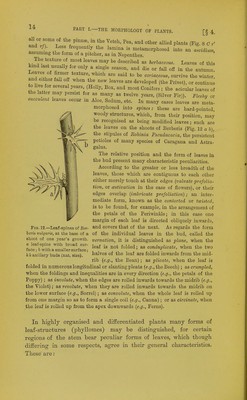

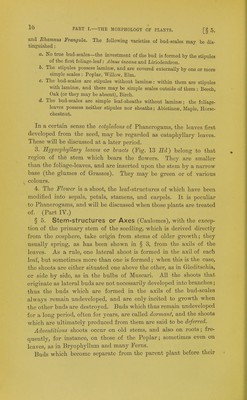

 No text description is available for this image
 No text description is available for this image
 No text description is available for this image