An elementary text-book of botany / translated from the German of K. Prantl ... ; the translation revised by S.H. Vines.
- Prantl, Karl Anton Eugen, 1849-1893.
- Date:
- 1881
Licence: Public Domain Mark
Credit: An elementary text-book of botany / translated from the German of K. Prantl ... ; the translation revised by S.H. Vines. Source: Wellcome Collection.
Provider: This material has been provided by University of Bristol Library. The original may be consulted at University of Bristol Library.
49/360 page 37
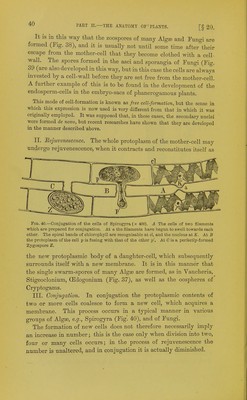
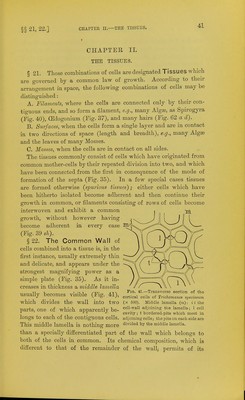
![§20.] fining process; in tlie cells of many kinds of fruits, as the grape and others, it contains grape-sugar. Besides these substances, tannin and iuulin occur, as well as acids, such as malic acid in the apple and other fruits, citric acid in lemons, etc. It also contains the colouring-matters of most red and blue flowers (Brythrophyll and Anthocyanin), and of many fruits, as the cherry and elder berry, with many other substances. § 20. The Development of Cells always takes place in such wise that the whole or part of the protoplasm of a cell already existing, the mother-cell, undergoes re-arrange- ment. The following are the prin- cipal modes of cell-formation: I. Cell-division. The protoplasm of the mother-cell separates into two or more parts, each of which consti- tutes a new cell. The division of the protoplasm is usually preceded by that of the nucleus. Cases in whicli the protoplasm has been observed to divide before the nucleus occur in the development of the spores of An- thoceros and of the macrospores of Isoetes. Fig. 35.—Cell-division in the cortex of the growing stem of Vicia Faha (x 300). At a the division has just taken place, the nucleus 7c still adheres to the new wall; at i) it has retreated to the older wall. In the simplest case of cell-division the nucleus divides into two, the protoplasm does the same, and a cell-wall is formed in the plane of division. In other cases the secondary nuclei and their investing protoplasm may again divide before any cell-wall is formed. Finally, the formation of a cell-wall may be postponed until the division of the nuclei and of the protoplasm has been repeated an indefinite number of times. The varieties of cell-division which thus arise may be arranged as follows : 1. In growing vegetative organs, a division of the cell takes place, such that the whole of its protoplasm, without any rounding- ofE or contraction, is divided into two parts: the new wall is formed between the two masses of protoplasm only along the plane of divi- sion (Fig. 35). The wall is sometimes formed simultaneously at all points of the plane of division, as in the development of stomata, and sometimes, as in certain Algte, e.g., Spirogyra, it grows as a ring from without inwards.](https://iiif.wellcomecollection.org/image/b21446052_0049.jp2/full/800%2C/0/default.jpg)



 No text description is available for this image
 No text description is available for this image
 No text description is available for this image