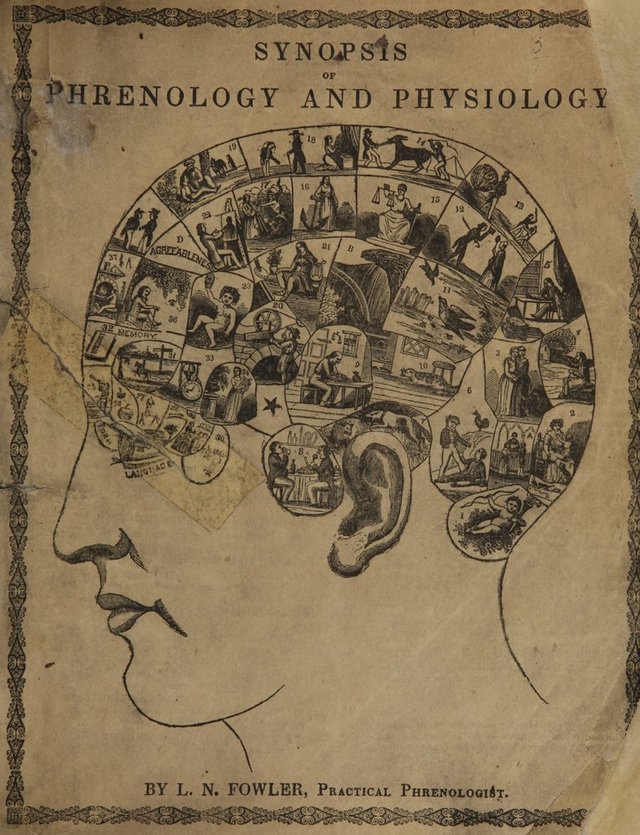
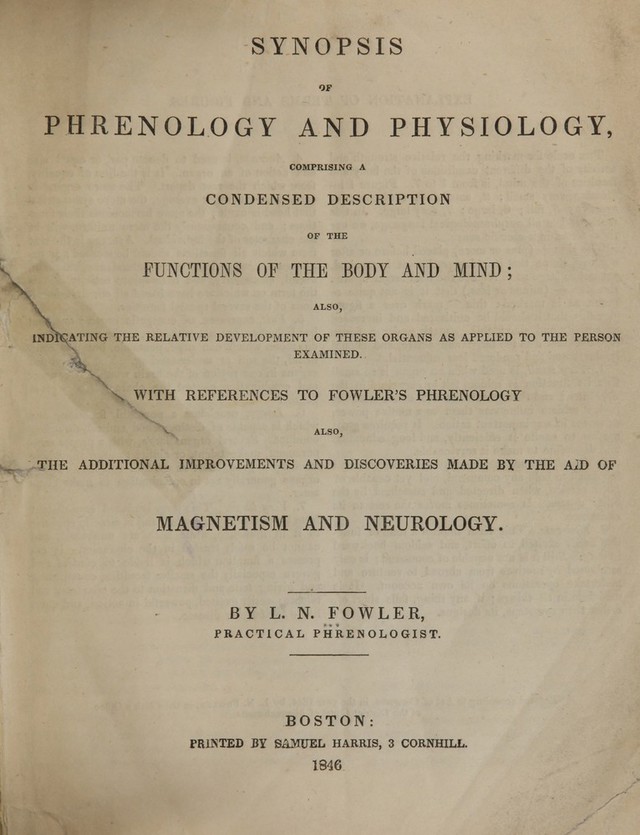
Synopsis of phrenology and physiology : comprising a condensed description of the functions of the body and mind : also, indicating the relative development of these organs as applied to the person examined : with references to Fowler's phrenology, also, the additional improvements and discoveries made by the aid of magnetism and neurology / by L.N. Fowler.
- Lorenzo N. Fowler
- Date:
- 1846
Licence: Public Domain Mark
Credit: Synopsis of phrenology and physiology : comprising a condensed description of the functions of the body and mind : also, indicating the relative development of these organs as applied to the person examined : with references to Fowler's phrenology, also, the additional improvements and discoveries made by the aid of magnetism and neurology / by L.N. Fowler. Source: Wellcome Collection.
Provider: This material has been provided by the National Library of Medicine (U.S.), through the Medical Heritage Library. The original may be consulted at the National Library of Medicine (U.S.)
10/28
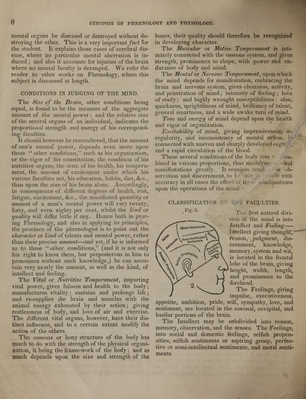
![mental organs be diseased or destroyed without de- stroying the other. This is a very important fact For the student. It explains those cases of cerebral dis- ease, where no particular mental aberration is in- duced ; and also it accounts for injuries of the brain where no mental faculty is deranged. We refer the reader to other works on Phrenology, where this subject is discussed at length. CONDITIONS IN JUDGING OF THE MIND. The Size of the Brain, other conditions being equal, is found to be the measure of the aggregate amount of the mental power ; and the relative size of the several organs of an individual, indicates the proportional strength and energy of his correspond- ing faculties. It should however be remembered, that the amount of one's mental power, depends even more upon these other conditions, such as his organization, or the vigor of his constitution, the condition of his nutritive organs, the state of his health, his tempera- ment, the amount of excitement under which his various faculties act, his education, habits, diet, &c, than upon the size of his brain alone. Accordingly, in consequence of different degrees of health, rest, fatigue, excitement, &c, the manifested quantity or amount of a man's mental power will vary twenty, forty, and even eighty per cent, whilst the kind or quality will differ little if any. Hence both in prov- ing Phrenology, and also in applying its principles, the province of the phrenologist is to point out the character or kind of talents and mental power, rather than their precise amount—and yet, if he is informed as to these other conditions, (and it is not only his right to know them, but preposterous in him to pronounce without such knowledge,) he can ascer- tain very nearly the amount, as well as the kind, of intellect and feeling. The Vital or Nutritive Temperament, imparting vital power, gives fulness and health to the body; manufactures vitality ; sustains and prolongs life; and re-supplies the brain and muscles with the animal energy exhausted by their action; giving restlessness of body, and love of air and exercise. The different vital organs, however, have their dis- tinct influence, and to a certain extent modify the action of the others. The osseous or bony structure of the body has much to do with the strength of the physical organi- zation, it being the frame-work of the body ; and as much depends upon the size and strength of the bones, their quality should therefore be recognized in developing character. The Muscular or Motive Temperament is inti- mately connected with the osseous system, and gives strength, prominence to shape, with power ahd en- durance of body and mind. The Mental or Nervous Temperament, upon which the mind depends for manifestation, embracing the brain and nervous system, gives clearness, activity, and penetration of mind; intensity of feeling ; love of study ; and highly wrought susceptibilities : also, quickness, sprightliness of mind, brilliancy of talent, general smartness, and a wide awake turn of mind. Tone and energy of mind depend upon the health and vigor of organization. Excitability of mind, giving impressiveness, ir- regularity, and inconsistency of mental action, > connected with uneven and sharply developed - and a rapid circulation of the blood. These several conditions of the body ' ii- bined in various proportions, thus modify in ital manifestations greatly. It requires muo] ^e ob- servation and discernment, to 1 ible id*i with accuracy in all cases the effect of tl mibinations upon the operations of the mind. CLASSIFICATION FACULTIES. The first natural divi- sion of the mind is into Intellect and Feeling.— Intellect giving thought, reason, judgment, dis- cernment, knowledge, memory, system and wit, is located in the frontal lobe of the brain, giving height, width, length, and prominence to the forehead. The Feelings, giving impulse, executiveness, appetite, ambition, pride, will, sympathy, love, and sentiment, are located in the coronal, occipital, and basilar portions of the brain. The Intellect may be subdivided into reason, memory, observation, and the senses. The Feelings, into social and domestic feelings, selfish propen- sities, selfish sentiments or aspiring group, perfec- tive or semi-intellectual sentiments, and moral senti- ments](https://iiif.wellcomecollection.org/image/b21120341_0010.jp2/full/800%2C/0/default.jpg)