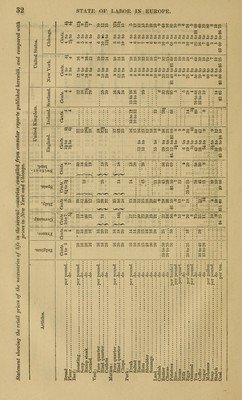
State of labor in Europe, 1878 : reports from United States Consuls in the several countries of Europe on rates of wages, cost of living to the laborers, past and present rates, present condition of trade, business habits, and systems, amount of paper money in circulation, and its relative value to gold and silver : for the several consular districts, in response to a circular from the Department of State requesting information upon these subjects ; together with a letter from the Secretary of State transmitting these reports to the Speaker of the House of Representatives.
- Date:
- 1879
Licence: Public Domain Mark
Credit: State of labor in Europe, 1878 : reports from United States Consuls in the several countries of Europe on rates of wages, cost of living to the laborers, past and present rates, present condition of trade, business habits, and systems, amount of paper money in circulation, and its relative value to gold and silver : for the several consular districts, in response to a circular from the Department of State requesting information upon these subjects ; together with a letter from the Secretary of State transmitting these reports to the Speaker of the House of Representatives. Source: Wellcome Collection.
Provider: This material has been provided by the Harvey Cushing/John Hay Whitney Medical Library at Yale University, through the Medical Heritage Library. The original may be consulted at the Harvey Cushing/John Hay Whitney Medical Library at Yale University.
![the houses [the property of the coal-owners] which they occupied rent free. At the end of the strike and the victory of the company, all the old hands were re-engaged.— From the report of Consul Jones. Sonneberg, Germany.—The manufacturers are producing atunprofitahle prices in order to keep their hands employed.—From the report of Consul Winser. Brussels, Belgium.—The owners of these establishments have made it a point to identify the workmen as much as possible with the place of their employment, so as to secure permauence and uniformity of employed labor. Consequently, in such times as the present, employers make every possible concession to the workingmen.—From the report of Consul Wilson. 8. That the railroads of Europe, especially those of France and Ger- many, are so conducted as to make the interests of the employe's as identical with the interests of the company as is possible—which will be seen by reading the very interesting reports from La Eochelle, Lyons, and Paris, where they refer to the subject, for France; and the reports from Bremen, Chemnitz, and Frankfort-on-the-Main, for Germany—the results of which wisdom on the part of the companies may be summed up in a few words: Good conduct and steadiness insure permanent em- ployment at good wages, with the further incentive to the employes that economy and care in fuel and of the property of the companies brings the employes a good percentage, which increases their annual wages considerably. The consul at La Eochelle, noting the good conduct of the French railway employes, says: Brotherhoods, or other such organizations, are unknown. No strikes occur, and the relations between the employe's and the companies are entirely harmonious. The consul at Lyons, who writes at length on the railway systems of France, says: On the whole, there appears to be no valid reason why our railway employe's, of every rank and condition, should not, on comparing their pay and condition with those of their brethren in France, be every way contented and satisfied. 9. That the average American workman performs from one and a half to twice as much work, in a given time, as the average European work- man. This is so important a point, in connection with our ability to compete with the cheap-labor manufactures of Europe, and it seems, on first thought, so strange, that I will trouble you with somewhat lengthy quotations from the reports in support thereof: Denmark.—Another evil is the diminished worth of wages, the descending quantity and quality of work now obtained by employers for wages higher than those paid ten years ago.—From the report of the consul at Copenhagen. France.—At his work the French laborer or mechanic lacks the energy of the Ameri- can of the same class, and the amount of work executed by him is much less in the same number of hours. The hours of labor are from eleven to twelve, but an average American workman will accomplish as much in nine hours.—From the report of the con- sul at Bordeaux. Germany.—I am satisfied that an ordinary workingman in the United States will do as much again as will one in this district in the same time.—From the report of tlie con- sul at Chemnitz, Saxony. An active American workman will do as much work in a given time, at any employ- ment, as two or three German workmen.—From the report of the consul at Leipsic. There can be no question that, speaking in general terms, the quality as well as the quantity of the work of the German artisans is inferior to that produced by the Ameri- cans. The workman here is inclined to be sluggish, and what he accomplishes is rel- atively small.—From the report of the consul at Sonneberg. For the first time our manufactures are now assuming international proportions. At a time of universal depression we have met those na- tions which held a monopoly of the world's markets, met thein in their strongholds, and established the fact that American manufactures are second to the manufactures of no other nation, and that, with a proper](https://iiif.wellcomecollection.org/image/b21002447_0042.jp2/full/800%2C/0/default.jpg)