[Report of the Medical Officer of Health for London County Council 1962].
- London County Council (London, England). County of London.
- Date:
- 1963
Licence: Attribution-NonCommercial 4.0 International (CC BY-NC 4.0)
Credit: [Report of the Medical Officer of Health for London County Council 1962]. Source: Wellcome Collection.
133/165 (page 128)
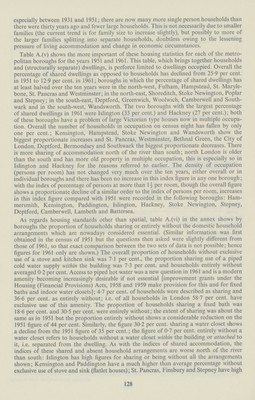
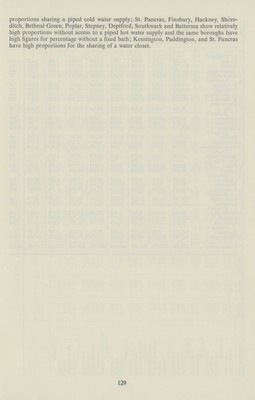
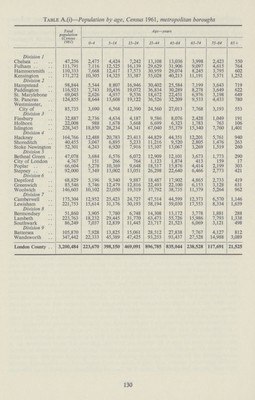
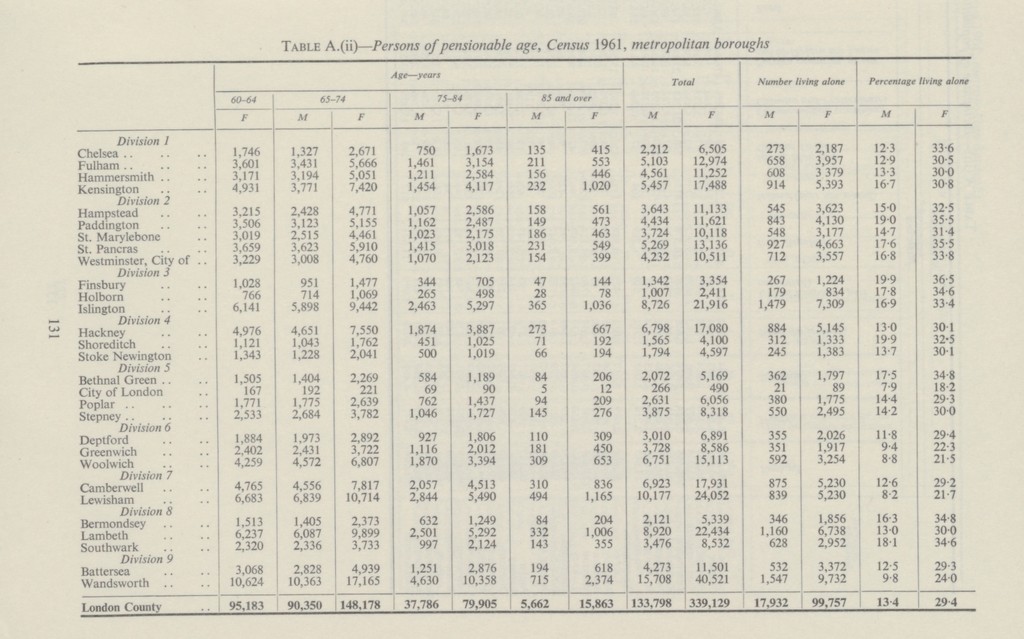
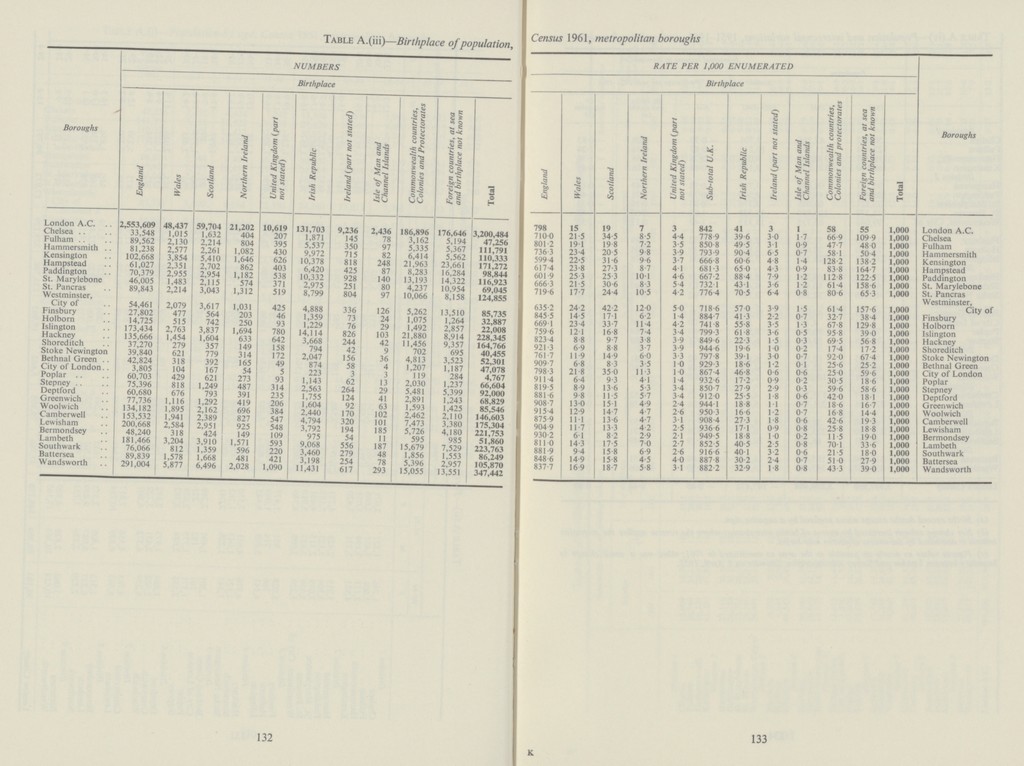
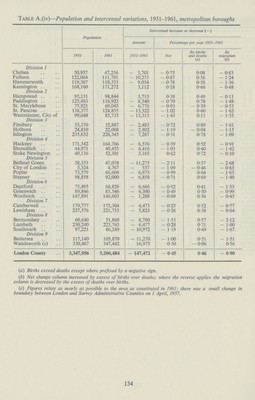
![especially between 1931 and 1951; there are now many more single person households than there were thirty years ago and fewer large households. This is not necessarily due to smaller families (the current trend is for family size to increase slightly), but possibly to more of the larger families splitting into separate households, doubtless owing to the lessening pressure of living accommodation and change in economic circumstances. Table A.(v) shows the more important of these housing statistics for each of the metro politan boroughs for the years 1951 and 1961. This table, which brings together households and (structurally separate) dwellings, is perforce limited to dwellings occupied. Overall the percentage of shared dwellings as opposed to households has declined from 25.9 per cent. in 1951 to 12.9 per cent. in 1961; boroughs in which the percentage of shared dwellings has at least halved over the ten years were in the north-west, Fulham, Hampstead, St. Maryle bone, St. Pancras and Westminster; in the north-east, Shoreditch, Stoke Newington, Poplar and Stepney; in the south-east, Deptford, Greenwich, Woolwich, Camberwell and South wark and in the south-west, Wandsworth. The two boroughs with the largest percentage of shared dwellings in 1961 were Islington (33 per cent.) and Hackney (27 per cent.); both of these boroughs have a problem of large Victorian type houses now in multiple occupa tion. Overall the number of households in occupation on census night has fallen by only one per cent.; Kensington, Hampstead, Stoke Newington and Wandsworth show the biggest proportionate increases and St. Pancras, Westminster, Bethnal Green, the City of London, Deptford, Bermondsey and Southwark the biggest proportionate decreases. There is more sharing of accommodation north of the river than south; north London is older than the south and has more old property in multiple occupation, this is especially so in Islington and Hackney for the reasons referred to earlier. The density of occupation (persons per room) has not changed very much over the ten years, either overall or in individual boroughs and there has been no increase in this index figure in any one borough; with the index of percentage of persons at more than 1½ per room, though the overall figure shows a proportionate decline of a similar order to the index of persons per room, increases in this index figure compared with 1951 were recorded in the following boroughs: Ham mersmith, Kensington, Paddington, Islington, Hackney, Stoke Newington, Stepney, Deptford, Camberwell, Lambeth and Battersea. As regards housing standards other than spatial, table A.(vi) in the annex shows by boroughs the proportion of households sharing or entirely without the domestic household arrangements which are nowadays considered essential. (Similar information was first obtained in the census of 1951 but the questions then asked were slightly different from those of 1961, so that exact comparison between the two sets of data is not possible; hence figures for 1961 only are shown.) The overall proportion of households without exclusive use of a stove and kitchen sink was 7.1 per cent., the proportion sharing use of a piped cold water supply within the building was 7.3 per cent. and households entirely without averaged 0.2 per cent. Access to piped hot water was a new question in 1961 and is a modern amenity becoming increasingly desirable if not essential [improvement grants under the Housing (Financial Provisions) Acts, 1958 and 1959 make provision for this and for fixed baths and indoor water closets]; 4.7 per cent. of households were described as sharing and 36.6 per cent. as entirely without; i.e. of all households in London 58.7 per cent. have exclusive use of this amenity. The proportion of households sharing a fixed bath was 18.6 per cent. and 30.5 per cent. were entirely without; the extent of sharing was about the same as in 1951 but the proportion entirely without shows a considerable reduction on the 1951 figure of 44 per cent. Similarly, the figure 30.2 per cent. sharing a water closet shows a decline from the 1951 figure of 35 per cent.; the figure of 0.7 per cent. entirely without a water closet refers to households without a water closet within the building or attached to it, i.e. separated from the dwelling. As with the indices of shared accommodation, the indices of these shared and absent household arrangements are worse north of the river than south: Islington has high figures for sharing or being without all the arrangements shown; Kensington and Paddington have a much higher than average percentage without exclusive use of stove and sink (flatlet houses); St. Pancras, Finsbury and Stepney have high 128](https://iiif.wellcomecollection.org/image/b18253064_0133.jp2/full/800%2C/0/default.jpg)