On the philosophy of discovery : chapters historical and critical / by William Whewell. Including the completion of the 3d ed. of the Philosophy of the inductive sciences.
- William Whewell
- Date:
- 1860
Licence: Public Domain Mark
Credit: On the philosophy of discovery : chapters historical and critical / by William Whewell. Including the completion of the 3d ed. of the Philosophy of the inductive sciences. Source: Wellcome Collection.
Provider: This material has been provided by the Harvey Cushing/John Hay Whitney Medical Library at Yale University, through the Medical Heritage Library. The original may be consulted at the Harvey Cushing/John Hay Whitney Medical Library at Yale University.
540/572 page 520
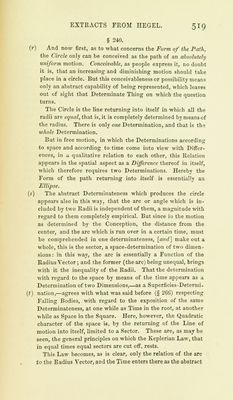
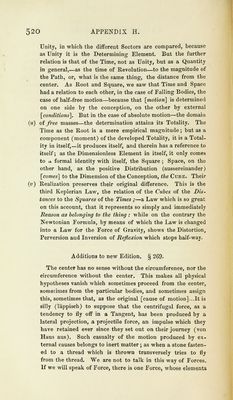
![Unity, in which the different Sectors are compared, because as Unity it is the Determining Element. But the further relation is that of the Time, not as Unity, but as a Quantity in general,—as the time of Revolution—to the magnitude of the Path, or, what is the same thing, the distance from the center. As Root and Square, we saw that Time and Space had a relation to each other, in the case of Falling Bodies, the case of half-free motion—because that [motion] is determined on one side by the conception, on the other by external [conditions]. But in the case of absolute motion—the domain (;/) of free masses—the determination attains its Totality. The Time as the Root is a mere empirical magnitude; but as a component (moment) of the developed Totality, it is a Total- ity in itself,—it produces itself, and therein has a reference to itself; as the Dimensionless Element in itself, it only comes to a. formal identity with itself, the Square ; Space, on the other hand, as the positive Distribution (aussereinander) [comes] to the Dimension of the Conception, the Cube. Their (v) Realization preserves their original difference. This is the third Keplerian Law, the relation of the Cubes of the Dis- tances to the Squares of the Times ;—a Law which is so great on this account, that it represents so simply and immediately Reason as belonging to the thing : while on the contrary the Newtonian Formula, by means of which the Law is changed into a Law for the Force of Gravity, shows the Distortion, Perversion and Inversion of Reflexion which stops half-way. Additions to new Edition. § 269. The center has no sense without the circumference, nor the circumference without the center. This makes all physical hypotheses vanish which sometimes proceed from the center, sometimes from the particular bodies, and sometimes assign this, sometimes that, as the original [cause of motion]...It is silly (1'appisch) to suppose that the centrifugal force, as a tendency to fly off in a Tangent, has been produced by a lateral projection, a projectile force, an impulse which they have retained ever since they set out on their journey (von Haus aus). Such casualty of the motion produced by ex- ternal causes belongs to inert matter; as when a stone fasten- ed to a thread which is thrown transversely tries to fly from the thread. We are not to talk in this way of Forces. If we will speak of Force, there is one Force, whose elements](https://iiif.wellcomecollection.org/image/b20999203_0540.jp2/full/800%2C/0/default.jpg)