The essentials of cytology: an introduction to the study of living matter / by Charles Edward Walker; preface by C.S. Sherrington.
- Walker Charles Edward.
- Date:
- 1907
Licence: In copyright
Credit: The essentials of cytology: an introduction to the study of living matter / by Charles Edward Walker; preface by C.S. Sherrington. Source: Wellcome Collection.
Provider: This material has been provided by the Royal College of Physicians of Edinburgh. The original may be consulted at the Royal College of Physicians of Edinburgh.
89/172 page 71
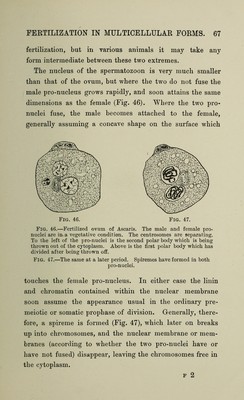
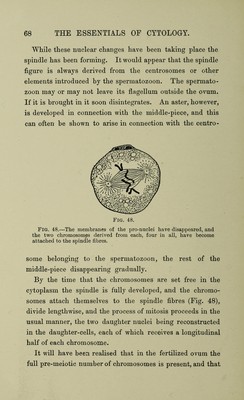
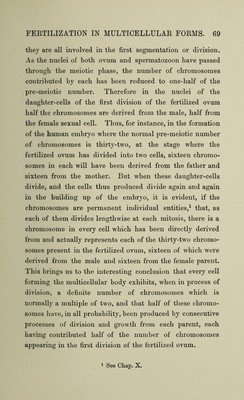
![the daughter-cells produced [polyspermy]. In some such cases development ceases at a comparatively early period, and the cells degenerate without producing an embryo. There are other irregularities which will be dealt with later on.1 In several species of plants and animals new individuals are produced without the fusion of male and female elements. The new individuals are produced by the females without any fertilization by the males taking place. This is known as parthenogenesis. In many such cases the female produces ova which develop into mature females, and this goes on for many generations without any males appear- ing. On the approach of winter, however, the existing generation of females produces both males and females, and then fertilization by the males occurs. In some species, however, there is apparently no fertilization at any period. Without going into details, which would be out of place in a short work of this nature, it may be said that there are two common modes by which new individuals are produced parthenogenetically. In one the ovum passes through the meiotic phase, and the number of chromosomes in what under ordinary circumstances would be the female pro- nucleus is thus reduced. Instead of the second polar body degenerating, however, it either remains in the ovum or returns into it, and plays the part usually filled by the spermatozoon, thus restoring the full pre-meiotic number of chromosomes to the first cleavage figure in the ovum, and consequently to all the cells subsequently derived from it. In other cases no reduction takes place, and so the full](https://iiif.wellcomecollection.org/image/b2172815x_0089.jp2/full/800%2C/0/default.jpg)