The elements of materia medica and therapeutics (Volume 2).
- Jonathan Pereira
- Date:
- 1843
Licence: Public Domain Mark
Credit: The elements of materia medica and therapeutics (Volume 2). Source: Wellcome Collection.
Provider: This material has been provided by the National Library of Medicine (U.S.), through the Medical Heritage Library. The original may be consulted at the National Library of Medicine (U.S.)
35/854
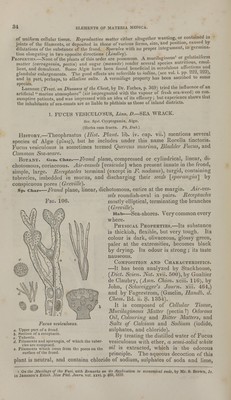
![and a mucilaginous substance somewhat analogous to pectin. It yields, with chlo- rine and starch, faint traces only of iodine. But if alcohol be added, by which the mucilage and a part of the sulphates are thrown down, the alcoholic liquor evaporated, and the residue mixed with potash, then calcined, and afterwards treated with hydrochloric acid to disengage hydrosulphuric acid, we may detect iodine in the filtered liquor by the deep blue colour formed on the addition of starch and chlorine. (Guibourt, Hist, des Drog. 3d ed. ii. 395.) By combustion in the open air, this plant yields an ash, called Kelp (vide Kelp); and by incineration in a covered crucible it gives a charcoal, termed Vegetable Ethiops. Physiological Effects.—During the winter, in some of the Scottish islands, horses, cattle, and sheep, are fed on it. (Greville, Algce. Brit, xx.) Its local action is detergent, and perhaps discutient. Its remote effects are probably analogous to those caused by small doses of iodine, modified by the influence of salts of sodium and calcium. Uses.—Frictions of the plant, with its contained mucus, were employed, with supposed advantage, by Dr. Russell, (Dissertation on the Use of Sea-Water, 5th ed. 1769, pp. 41 and 44,) in glandular enlargements and other scrofulous tumors: the parts were afterwards washed with sea-water. He also gave internally the expressed juice of the vesicles in glandular affections. {Op. cit. p. 99.) jETHIOPS VEGETABILIS; Vegetable Ethiops.—-This is prepared by incinerating Fucus vesiculosus in a covered crucible. It is composed of Charcoal, Chloride of Sodium, Carbonate of Soda, Sulphurets of Sodium and Calcium, and traces of an Alkaline Iodide. It has been exhibited in bronchocele and scrofulous maladies. Dr. Russell (Op. cit. p. 98,) says, it far exceeds burnt sponge in virtue. It has been employed also as a dentifrice. The dose of it is from ten grains to two drachms. 2. CHON'DRUS CRISTUS, Grev.—CARRAGEEN OR IRISH MOSS. (Chon'drus, U. S.) Sex. Syst. Cryptogamia, Algce. (Planta, Offic.) History.—It was introduced into medicine by Mr. Todhunter, of Dublin. (Reece's Monthly Gazette of Health, Jan. 1831.) It is sometimes sold as Pearl Moss. Botany. Gen. char.—Frond cartilaginous, dilating upwards into a flat, nerveless, dichotomously divided frond, of a purplish or livid red colour. Fructification: subspherical capsides [sporangia ?] in the substance of the frond (rarely supported on little stalks), and containing a mass of free seeds [sporules?~\ (Greville). Sp. char.—Frond plane, dichotomous, the segments linear, wedge-shaped. Capsules subhemispherical, imbedded in the disk of the frond (Greville). Hab.—On rocks and stones on the sea coast: very common. For dietetical and medicinal uses it is collected on the coasts of Ireland (especially in Clare), washed, bleached (by exposure to the sun), and dried. Physical Properties.—In the recent state it is purple-brown or purple-red, becoming greenish and ultimately whitish in decay. As met with in com- merce,1 it is dry, crisp, mostly yellowish or dirty white, but intermixed with purplish red portions, inodorous or nearly so, with a mucilaginous taste. It swells up in water. A calcareous meshy crust (consisting of various species of Flustrd) is frequently found on the frond. Composition.—It has been analyzed by Herberger, (Dierbach, Die neuesten i An anonymous reviewer (Edin. Mid. and Surg. Journ. vol. Iv. p. 220) states that Chondrus mammillosut in tolerably large quantity, is occasionally found in the carrageen of commerce.](https://iiif.wellcomecollection.org/image/b21146822_0035.jp2/full/800%2C/0/default.jpg)