An essay on the best modes of representing accurately, by statistical returns, the pressure and progress of the causes of mortality amongst different classes of the community, and amongst the populations of different districts and countries : with additional proofs and illustrations of the doctrine advanced in the Sanatory Report, that epidemic diseases increase the pressure of population / by Edwin Chadwick.
- Edwin Chadwick
- Date:
- [1844]
Licence: Public Domain Mark
Credit: An essay on the best modes of representing accurately, by statistical returns, the pressure and progress of the causes of mortality amongst different classes of the community, and amongst the populations of different districts and countries : with additional proofs and illustrations of the doctrine advanced in the Sanatory Report, that epidemic diseases increase the pressure of population / by Edwin Chadwick. Source: Wellcome Collection.
Provider: This material has been provided by The Royal College of Surgeons of England. The original may be consulted at The Royal College of Surgeons of England.
3/42
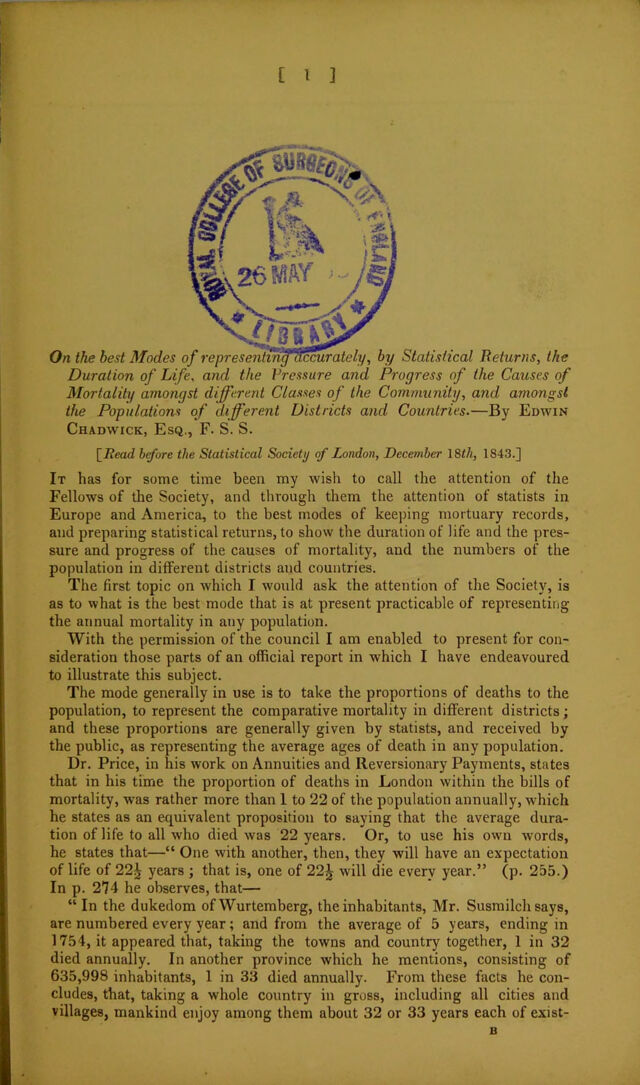
![Duration of Life, and the Vressure and Progress of the Causes of Mortality amongst different Classes of the Community, and amongst the Populations of different Districts and Countries,—By Edwin Chadwick, Esq,, F. S. S. \_Read hfore the Statistical Society of London, December \Stli, 1843.] It has for some time been my wish to call the attention of the Fellows of the Society, and through them the attention of statists in Europe and America, to the best modes of keeping mortuary records, and preparing statistical returns, to show the duration of life and the pres- sure and progress of the causes of mortality, and the numbers of the population in different districts and countries. The first topic on which I would ask the attention of the Society, is as to what is the best mode that is at present practicable of representing the annual mortality in any population. With the permission of the council I am enabled to present for con- sideration those parts of an official report in which I have endeavoured to illustrate this subject. The mode generally in use is to take the proportions of deaths to the population, to represent the comparative mortality in different districts; and these proportions are generally given by statists, and received by the public, as representing the average ages of death in any population. Dr. Price, in his work on Annuities and Reversionary Payments, states that in his time the proportion of deaths in London within the bills of mortality, was rather more than 1 to 22 of the population annually, which he states as an equivalent proposition to saying that the average dura- tion of life to all who died was 22 years. Or, to use his own words, he states that—“ One with another, then, they will have an expectation of life of 22^ years ; that is, one of 22J will die every year.” (p. 255.) In p. 274 he observes, that— “ In the dukedom of Wurtemberg, the inhabitants, Mr. Susmilch says, are numbered every year; and from the average of 5 years, ending in 1754, it appeared that, taking the towns and country together, 1 in 32 died annually. In another province which he mentions, consisting of 635,998 inhabitants, 1 in 33 died annually. From these facts he con- cludes, that, taking a whole country in gross, including all cities and villages, mankind enjoy among them about 32 or 33 years each of exist- B](https://iiif.wellcomecollection.org/image/b22396214_0005.jp2/full/800%2C/0/default.jpg)